


We view Silicon Valley as a hub of original innovation. Tech giants are seen as pristine monuments of engineering, with intellectual property built line by line through massive capital and decades of rigorous R&D. However, when market pressure threatens corporate survival, the line between pioneering and theft rapidly blurs. As I learned firsthand, the tactics used to grow a global AI giant behind a polished corporate facade are fundamentally identical to those used in the large-scale, institutionalized counterfeiting operations I witnessed in China.
About eight years ago, I traveled through Guangzhou, China. Walking through the city’s bustling commercial hubs, I witnessed something that completely reframed my view of intellectual property and the boundaries of corporate conduct.
To understand the scale of what I saw, you have to contrast it with the counterfeiting we are accustomed to in the West. In New York’s Chinatown or along Canal Street, illicit commerce operates perpetually on the defensive. The sellers know they are crossing a strict legal and ethical line, so they keep their operations small, localized, and highly fluid.
If you walk those blocks, you notice the knockoff goods are draped under tarps or tucked away in trash bags. Sellers operate out of the trunks of cars or in hidden backrooms, constantly scanning the street, ready to bolt at the first sign of law enforcement. Depending on the current political administration, they are aggressively targeted, raided, and shut down. They exist in the shadows because they know they lack the right to exist in the light.

 Tiktok failed to load.
Enable 3rd party cookies or use another browser
But in Guangzhou, I walked past full-scale, multi-level retail storefronts boldly displaying globally recognized logos: New Balance, Nike, Puma, Supreme. These weren’t hidden stalls or fleeting pop-ups; they were brazen, polished, fully realized corporate facades complete with modern lighting, glass entryways, and professional staff. Yet, the apparel inside was entirely unlicensed and replicated. They didn’t just copy a specific product; they institutionalized the theft of an entire corporate architecture. They had the audacity to put un-permissioned logos right on the building’s permanent storefront sign, operating entirely in the open because they relied on a systemic lack of enforcement and a culture that treated IP as a resource to be seized.
Why spend a decade innovating, investing in material science, and building supply chains when you can simply clone a legitimate foundation, slap your own storefront on it, and skip the line?


We are now watching this exact real-world dynamic play out in Silicon Valley’s digital and corporate space.
The Silicon Valley Facade
This is the bridge to Silicon Valley. We like to think of tech giants as the absolute pinnacle of original innovation—the clean, gleaming antithesis of physical clone markets. But when the pressure to win is high enough, the corporate behavior of hyper-growth AI giants is functionally identical to those multi-level storefronts in Guangzhou.
OpenAI did not just build a competing hardware team. They built the digital equivalent of a Guangzhou storefront: a $6.4 billion subsidiary, io Products, designed to look like a pristine, highly polished monument of AI innovation, but allegedly constructed from the ground up using stolen blueprints, unreleased physical components, and bypassed R&D.
Apple’s blockbuster 41-page trade secret lawsuit filed in California federal court reveals that OpenAI didn’t just cross an ethical line in secret—they normalized a culture of institutionalized extraction, operating in broad daylight while assuming their sheer speed and valuation would make them untouchable.
Inside the “Hardware Heist”
To accelerate its own hardware plans and bypass decades of Apple’s R&D, the complaint alleges that OpenAI established a systematic, highly organized pipeline of extraction:
The “Show and Tell” Recruitment: OpenAI’s Chief Hardware Officer—and former Apple VP of Product Design for the iPhone and Apple Watch—Tang Tan, allegedly directed candidates still employed by Apple to bring actual unreleased physical prototypes, logic boards, and components to their job interviews. Candidates were grilled using core technical files, CAD drawings, and system-in-package (SiP) layouts to reverse-engineer Apple’s supply chain and engineering thought process.
The Network Flaw Loophole: Former Apple senior system electrical engineer Chang Liu allegedly failed to return his company-issued laptop upon departing. Utilizing an unpatched authentication bug, he discovered he still retained full access to Apple’s internal networks after starting his employment at OpenAI. He reportedly texted a colleague: “LOL, I found out I can access the [network storage], so funny.” The lawsuit claims he used this backdoor to download a massive compilation of over 1,000 pages of confidential hardware files, technical specifications, and manufacturing blueprints for unreleased products.
Deceiving the Supply Chain: OpenAI allegedly approached trusted, secretive Apple manufacturing partners using inside terminology. The suit claims they successfully deceived one vendor into applying Apple’s proprietary, highly guarded metal-finishing technique to OpenAI’s own prototypes by falsely claiming that Apple had authorized the work.
Evading Corporate Security: The suit alleges that OpenAI actively circulated a highly confidential internal Apple document titled “Need to Know” to incoming poaches. This file outlined Apple’s employee offboarding security protocols, and OpenAI leadership allegedly used it to coach recruits on how to exfiltrate files and hide their new employment from Apple for as long as possible.
Like those storefronts in Guangzhou, a sleek, multi-billion-dollar corporate facade was built on top of an un-permissioned, misappropriated foundation.
The Systemic Crisis of Extraction
This behavior exposes a profound, structural rot within the technology sector. When the race for AI dominance intensified, the instinct of the industry’s most prominent players wasn’t to pioneer new paths of integrity—it was to extract. They treated un-permissioned data, sovereign intellectual property, and proprietary research as a free, open-source resource, operating under the gamble that speed-to-market would outrun legal accountability.
For years, the technology industry has normalized this behavior under the guise of “disruption.” But the legal landscape is shifting rapidly, and the “move fast and break things” playbook is hitting a hard wall.
This lawsuit proves that building technology on a foundation of toxic, un-permissioned assets is no longer just an ethical misstep—it is a catastrophic operational and legal liability. A multi-billion-dollar product pipeline can now be frozen instantly by a federal injunction if the underlying data architecture is proven to be compromised.
The Legal and Policy Shift We Need
From a legal and systemic perspective, a fundamental correction must happen. We cannot build a trustworthy digital economy on counterfeit foundations. To resolve this, our legal and policy frameworks must undergo two structural shifts:
1. The End of Architectural Extraction
The law must draw a firm, unyielding line between legitimate innovation and institutionalized data heists. Courts must enforce strict accountability at the architectural level.
If the foundation of a model, dataset, or device is proven to rely on un-permissioned, misappropriated material, the law should not merely fine the offender—it must establish that the commercial product cannot stand. We must legally recognize that stolen inputs render the output toxic.
2. The Mandate for Verifiable Provenance
We must transition to a legal framework where data and intellectual property integrity are verified at the source. Just as global commerce relies on strict supply-chain provenance to eliminate counterfeit goods or conflict minerals, the digital ecosystem requires verifiable, permissioned provenance for the human data signals and technical assets it trains on.
Data must meet the four core pillars of integrity to be legally viable in enterprise applications:
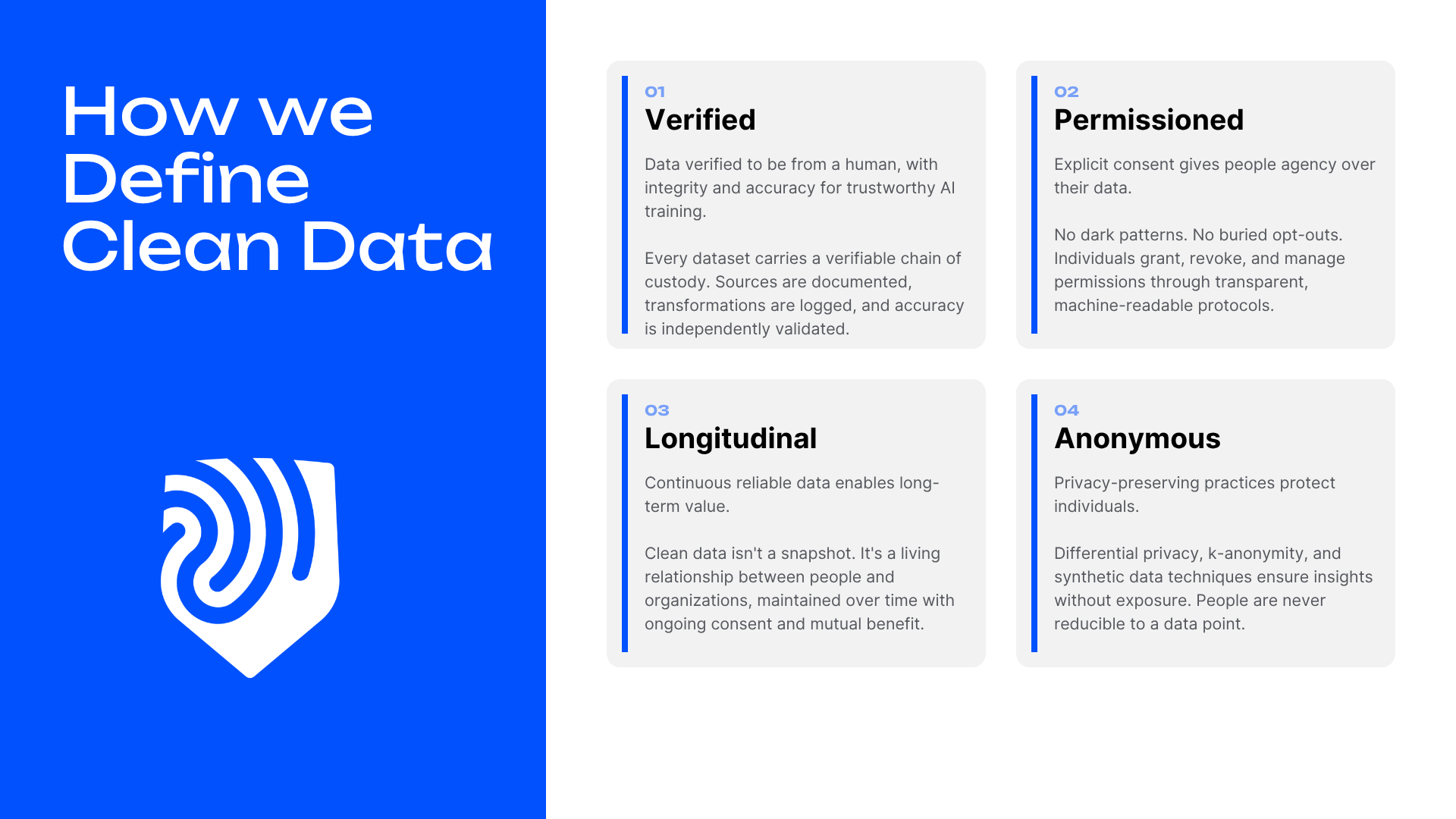
The current AI and hardware gold rush is built on a house of cards. The future belongs to an ecosystem where data is clean, permissions are absolute, and sovereignty is protected by law. That is the standard the Clean Data Alliance will continue to champion.
Ongoing Commentary & Coverage
For deeper analysis on the evolving legal strategies, structural implications, and tech fallout of this case, review the following industry coverage:
For the initial breaking coverage of the federal filing and corporate statements, read the Washington Post Analysis on the Apple-OpenAI Lawsuit.
To read a granular breakdown of the specific “Need to Know” document exfiltration and operational shortcuts, check out MacRumors’ Legal Report.
For an investigation into the supply chain deception, Tang Tan’s interview tactics, and the broader context of OpenAI poaching 400+ Apple employees, view 9to5Mac’s Deep Dive.
To explore the broader geopolitical and economic context of how this disruption threatens OpenAI’s impending Wall Street IPO, read the LiveMint Corporate Analysis.