


I recently scored tickets to Fanatics Fest NYC through a radio station giveaway.
Within a span of a few hours, I had a cold beer handed to me by Broadway Joe Namath himself, watched Kevin Hart play beer pong, and stood a few feet away watching several New York Knicks try their hand at shooting soccer balls and failing miserably. It was a truly memorable day with my son.
But as we walked the floor, riding that high, the data advocate in me couldn't help but notice the trap doors hidden beneath all the spectacle. Because while the memories were free (after the admission cost, of course), the "free" merchandise and giveaways around us came with a massive hidden price tag.
The Illusion of the Free Giveaway
On the surface, it’s a standard promotional sweepstakes. You scan a QR code, fill out a quick form, and get entered to win a trip, a rare card, or a fat discount. Legally, they cover their bases with a tiny, microscopic “no purchase necessary” disclosure.
But the prize is just a shiny distraction. It’s the incentive designed to make you voluntarily hand over the exact fields a marketing database needs.
These booths aren’t trying to give away Super Bowl tickets out of the goodness of their hearts; they are running a massive data-collection campaign that happens to have a prize attached.
The Six Main Offenders
The same underlying data grab was observed across completely different sports and brands:
Premier Padel × Qatar Airways: Promised a trip to the Miami P1 Tournament. The cost? First/last name, email, phone with country code, gender, birthdate, country, and city—plus three separate marketing opt-in checkboxes.
Fanatics × Topps Digital: Dangled a rare “Purple Mojo” trading card. However, the QR code funneled users into downloading the Topps Total Football app, forcing a secondary, full account sign-up before you could even claim the raffle entry.
Paris Saint-Germain (PSG): Used a shared tablet kiosk for a Champions League trivia contest. It demanded your email, birthdate, country, and a mandatory “Yes/No” toggle for marketing consent where “No” wasn’t a real option if you wanted to play.
NFL Auction / NFL Foundation: Tied a raffle for Super Bowl LXI tickets to a paid transaction (”entries start at $10”), leveraging charitable giving to smooth over aggressive data capture.
NHL × Honda: A free-standing sign for the 2027 All-Star Weekend on Long Island. The QR code routed traffic through a third-party marketing platform (flowcode) before reaching the form—adding an invisible, untracked third-party data hop.
American Express × Fanatics Fest: Offered 10% back on merchandise. Not framed as a giveaway, but used the exact same “scan to enroll” mechanic to link physical purchase categories directly to cardholder marketing profiles.


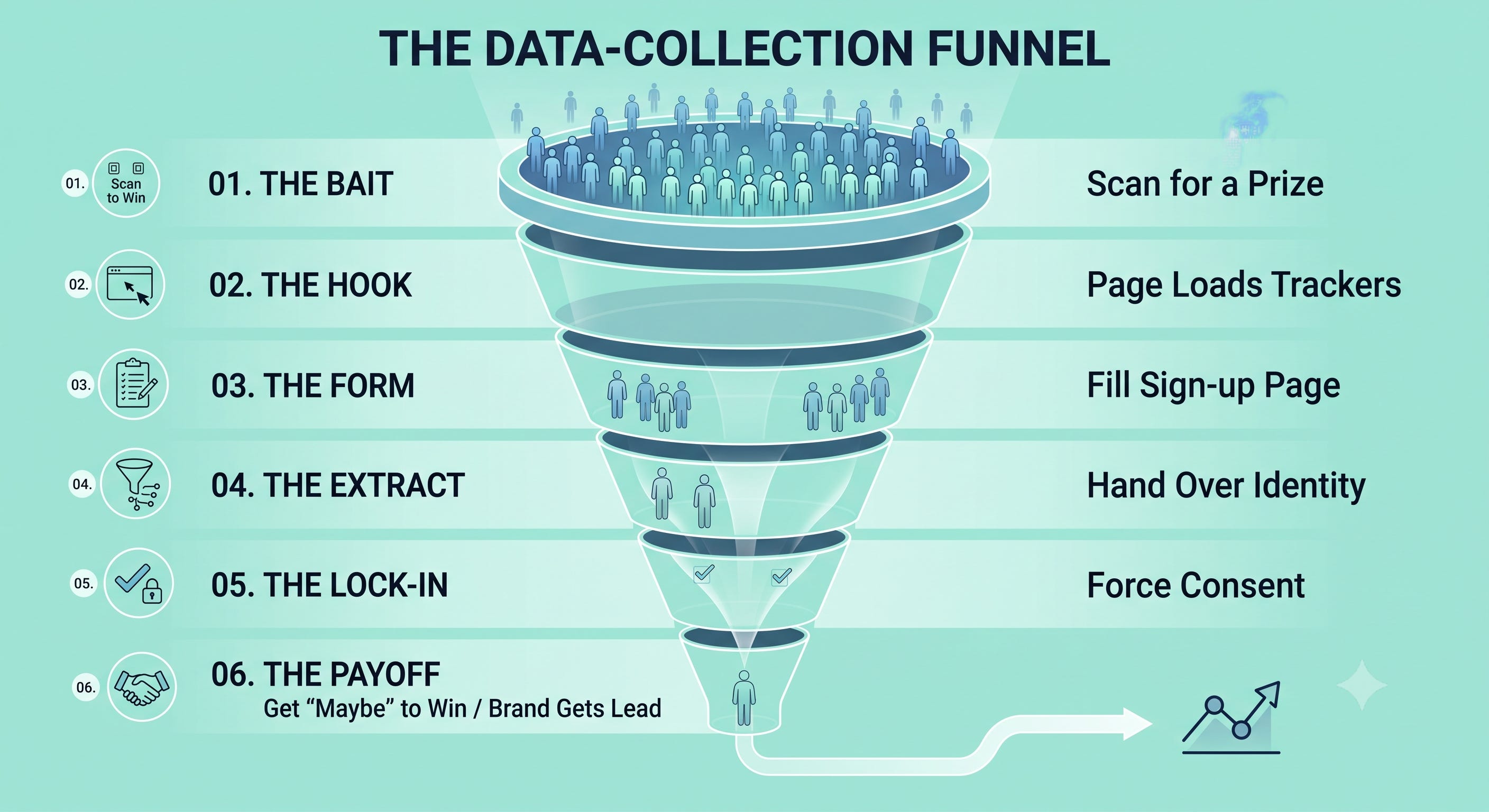
Anatomy of the Data-Collection Funnel
Every single one of these booths used a highly optimized six-step funnel designed to strip your data away before you even realize what happened.
The 6 Fields No Raffle Actually Needs
To pick a raffle winner, a company legally only needs a name and one way to contact you. Everything else is a marketer’s wish list:
Email Address: The core digital identifier used to build a permanent profile and match your data across brokers.
Full Birthdate: Day, month, and year. This isn’t age verification—it’s high-value identity data.
Country & City: Used for hyper-targeted local advertising.
Phone Number: Opens the floodgates for SMS marketing and tracking.
Gender: Used purely for ad-audience segmentation.
“Yes/No” Marketing Consent: Frequently framed so that saying “No” quietly disqualifies your entry entirely.
“The badge said NFL. The tablet said PSG. The sign said NHL. The form asked the exact same six questions every time. That’s not six brands running six promotions—that’s one data-collection playbook, licensed out to whoever has a booth this weekend.”
The Real Cost: Unpaid Labor On Your Weekend
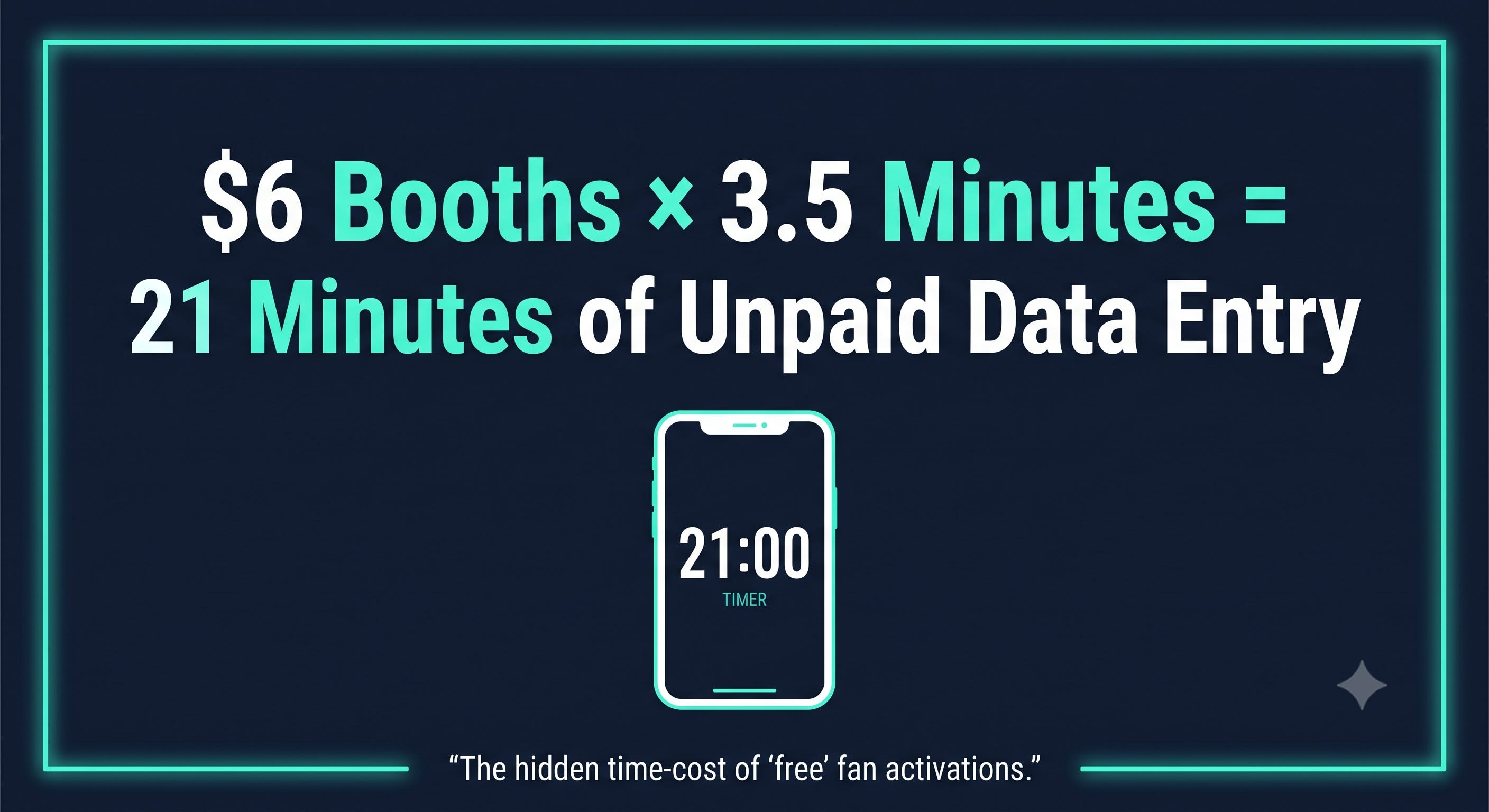
The ultimate joke is that the hidden cost isn’t just your digital footprint—it’s your actual time. The entire spectacle relies on hiding the massive time cost of data entry. A quick scan seems harmless. But let’s look at the math:
If you go through just six or seven of these clunky data-entry funnels across an afternoon, fighting through their broken dropdown menus and rigid forms, you’ve just spent over twenty minutes standing in a crowded convention hall, doing unpaid data-entry labor for a multinational corporation.
We are talking about some of the world’s biggest, most powerful sports and entertainment brands, yet many of the “digital funnels” they deploy look like they were thrown together on a lunch break with zero quality control. The forms are tedious, the interfaces are clunky, and the user experience is a complete afterthought. It’s an absolute circus: multibillion-dollar conglomerates demanding your precise personal data via mobile web interfaces that feel like relics from the early 2000s.
The sheer silliness of this massive, global, data-extraction operation being run on poorly optimized templates is mind-boggling. They want your entire digital identity, but they can’t even seem to build a smooth mobile web page. It’s a tragicomic collision of corporate greed and digital incompetence.
The Ultimate Punchline: “Get a Maybe to Win”
You give them a verified, high-value marketing profile. You sacrifice your precious weekend time. You grant invisible, permanent marketing consent. And what do you get in return?
A “maybe.”
They can’t even tell you the odds! You are trading your entire digital footprint and a solid chunk of your free time for a theoretical possibility of a prize that you will almost certainly never see. There are no odds disclosed, no transparent selection processes, just a poorly aligned confirmation screen and an open invitation for them to spam your inbox for the rest of your life.
The complete, hilarious asymmetry of the entire transaction is almost a work of art. The brand wins everything. The fan wins a potential headache and a statistical near-zero. It is, from every conceivable angle, the silliest, most ludicrous play in the corporate marketing playbook.
How to Protect Yourself at the Next Event
The next time you’re walking a convention floor or a stadium concourse, keep these ground rules in mind to keep from becoming an unpaid data-entry clerk:
Recognize the Bait: Treat every QR code sweepstakes like a cold-call data request. If a form asks for your full birthdate and gender just to enter a drawing, the giveaway is a data-mining exercise disguised as a game.
Use Aliases and Burners: Never give your primary contact information. Use a secondary “burner” email address specifically for events, and skip the phone number field unless the form literally blocks you from proceeding without it.
Opt Out of the Loop: Turn off notifications for digital card apps. Do not let push notifications dictate when you engage with an app. Recognize the “spin to win” wheels for what they are—psychological hooks designed to build an addiction.
Test the Consent Toggles: Don’t assume pre-checked boxes are mandatory. Uncheck the “partner marketing” options. If the form rejects your entry, laugh, appreciate the absurdity, and walk away—the trade isn’t worth it.
Enjoy the beer from Joe Namath and watch the beer pong—just keep your data clean while you do it. Don’t let your passion for the team blind you to the terrible playbook being run against you.
—
Two things can be true at the same time: Fanatics operates on a scale that requires massive, high-performing corporate machinery—but at its core, it succeeds because it operates as a deeply creative, boundary-pushing enterprise that completely redefines how fans interact with the brands they love.
Nothing of consequence changes until you become fanatical about the intersection of creative vision and raw execution. It’s exactly why I just wrote another highly positive piece breaking down the incredible business mechanics and ecosystem behind the Fanatics empire. Because when you build with that level of creative obsession, you don’t just participate in a market—you completely dominate it.
I don't know whether to laugh or cry. Someone needs to tell these marketing clowns that most of the data they collect will be useless garbage. And it is garbage in two possible dimensions.
1. The odds people entered in accurate, truthful information are very very low
2. Demographic data is largely meaningless at getting at what they really want to know
Moreover, targeting existing customers -- and the most likely passionate ones who would go to events like this -- with messages after the fact, doesn't do a f*cking thing to get new customers!
I basically left the marketing/advertising/sponsorship world because it is too impossibly stupid for me to tolerate. An industry that prides itself on 1% success rates is not one I want to be a part of in any way. Let's dumb down the entire society with shiny object attention-grabbing for useless data. Ya, I'll pass.