


If you were to look at your profile compiled by data brokers, it looks like a credit report—clean, tabular, and definitive. It lists your voter status, your estimated ethnicity, and dozens of numerical scores grading your interests from “Rock Concerts” to “Luxury Apparel” on a neat 0–10 scale.
But if you actually audited that profile line by line against reality, you would quickly realize that data brokers are selling statistical noise packaged as hard fact.
A recent internal case study of a profile pulled from a data broker reveals exactly how the industry manufactures false precision—and why its methodology is an ethical minefield for consumers.
The Illusion of a Fact
The profile in question contained 132 fields split across four standard categories:
Who You Are
Household & Finances
Purchases & Shopping
Interests & Attitudes.
At first glance, my data seemed remarkably accurate. Under identity fields, the broker correctly identified my registered voter status, language, and political party affiliation. Because these highly sensitive identity markers are 100% accurate, they lend an air of absolute authority to the rest of the document.
They aren’t. In fact, once the profile moves past public records, its accuracy plummets to a level barely better than a random guess.
When Stated Confidence Means Nothing
The broker ranks interests on a 0–10 scale, implying that a “9/10” score represents a behavior the broker is highly confident you engage in. When I ran a ground-truth accuracy check across all the interest tiers, the broker’s internal logic completely collapsed.
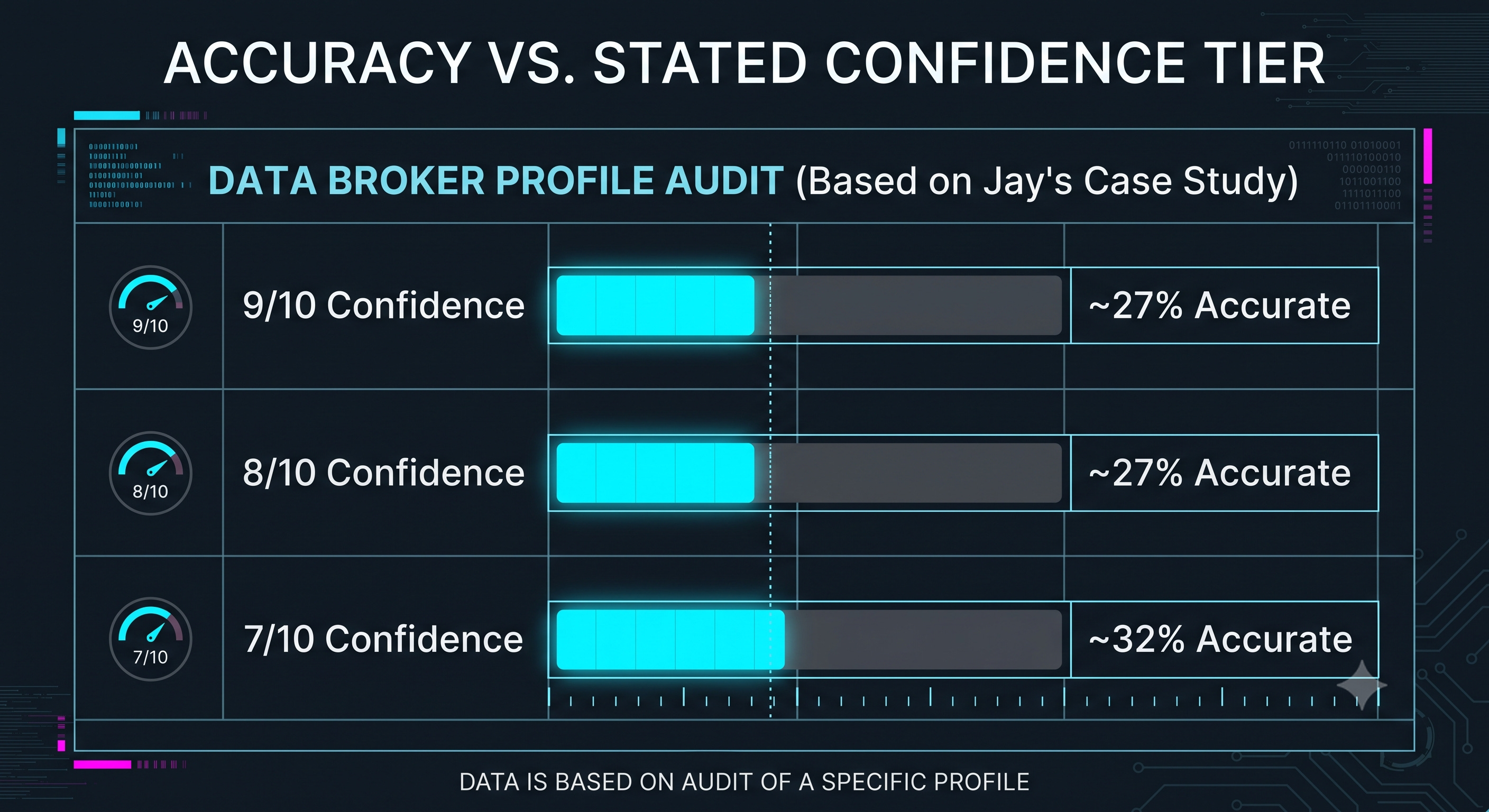
If these scores were genuine measures of predictability, a 9/10 score should be vastly more reliable than a 7/10 score. Instead, accuracy hovered between 27% and 32% across the board. A top-tier, high-confidence claim from the broker was wrong nearly three-quarters of the time.
Among the broker’s “most confident” (9/10) assertions were that I am a frequent flyer who frequently took foreign vacations, loved rock concerts, bought high-end electronics, and played tennis.
The reality? They fly occasionally, prefer R&B, drive a used car, and haven’t picked up a tennis racket since childhood.
The “I Wish” Algorithm: Lookalike Modeling
How does a multi-billion-dollar industry get things so confidently wrong? The answer lies in how the data is calculated.
Data brokers rely heavily on cohort or lookalike modeling. Rather than tracking your actual individual credit card transactions, the broker looks at a few hard data points like your zip code, age bracket, and income and flattens you into a consumer segment. If the average affluent professional in your neighborhood buys luxury goods and attends live theater, the algorithm assigns you a 9/10 score for those traits, too.
This creates two distinct systemic errors:
The Aspirational Overestimate: The broker systematically overestimates “aspirational lifestyle” categories (Luxury Cars, High Value Stocks, Life Insurance). The model isn’t recording what you do; it’s recording what advertisers want someone in your demographic to buy.
The Mundane Blindspot: Conversely, the broker rated basic, everyday realities very low. It estimated the likelihood of having health insurance at 1/10 and a home office at 2/10. Both untrue. Because these mundane, high-frequency attributes don’t fit the “affluent luxury traveler” segment profile, the algorithm missed them entirely.
Why False Precision Matters
This is not just a case of humorous corporate incompetence; it is a fundamental flaw in the digital economy that carries severe downstream risks.
The Core Problem: Inferences and statistical guesses are being packaged and distributed with the exact same visual and structural authority as verified public records.
These profiles are sold downstream to ad networks, insurance risk adjusters, political campaigns, and recruitment algorithms. A faulty inference regarding an individual’s health interests, financial aspirations, or ethnic background can follow them across the internet, altering the prices they see, the ads they are exposed to and the opportunities they are shown.
Until data brokers are forced to disclose their methodology, publish their true confidence intervals, and provide consumers with a transparent way to contest these algorithmic fabrications, we will remain trapped in an economy ruled by false precision—where corporate entities trade a fiction of who we are, one bad guess at a time.
Great read today I look forward to the day kluzy is ready to view and modify my data and allow me to own and manage