


I have been thinking about meat. That is admittedly an unusual place to begin an essay about artificial intelligence, advertising and data accountability. But the more I think about it, the less ridiculous the comparison seems. In fact, meat may offer a better way to explain the problem with modern data than much of the language we have invented for the technology industry.
Consider a very ordinary question: Where did this come from?
We ask that question constantly in the physical economy. We ask it about food, medicine, money, art, property and evidence. We instinctively understand that origin matters because it helps us establish authenticity, safety, ownership and accountability.
If someone offers you a Rolex at an implausibly low price, you want to know where it came from. If someone sells you a Picasso, provenance may determine if you have purchased a masterpiece or an expensive decoration. If you buy a house, it is reasonable to examine the chain of title. Aircraft have maintenance histories. Pharmaceuticals carry lot numbers. Used cars with documented histories are generally worth more than identical cars with unexplained gaps in their records.
And then there is meat.
For generations, we have built systems to inspect, grade, label and trace food because we collectively decided that “trust me” is not an adequate food-safety standard.
Yet as our economy has become increasingly dependent on data, we have tolerated something remarkably close to “trust me” as the operating model for information.
That strikes me as strange.
What if my steak had a tracking number?
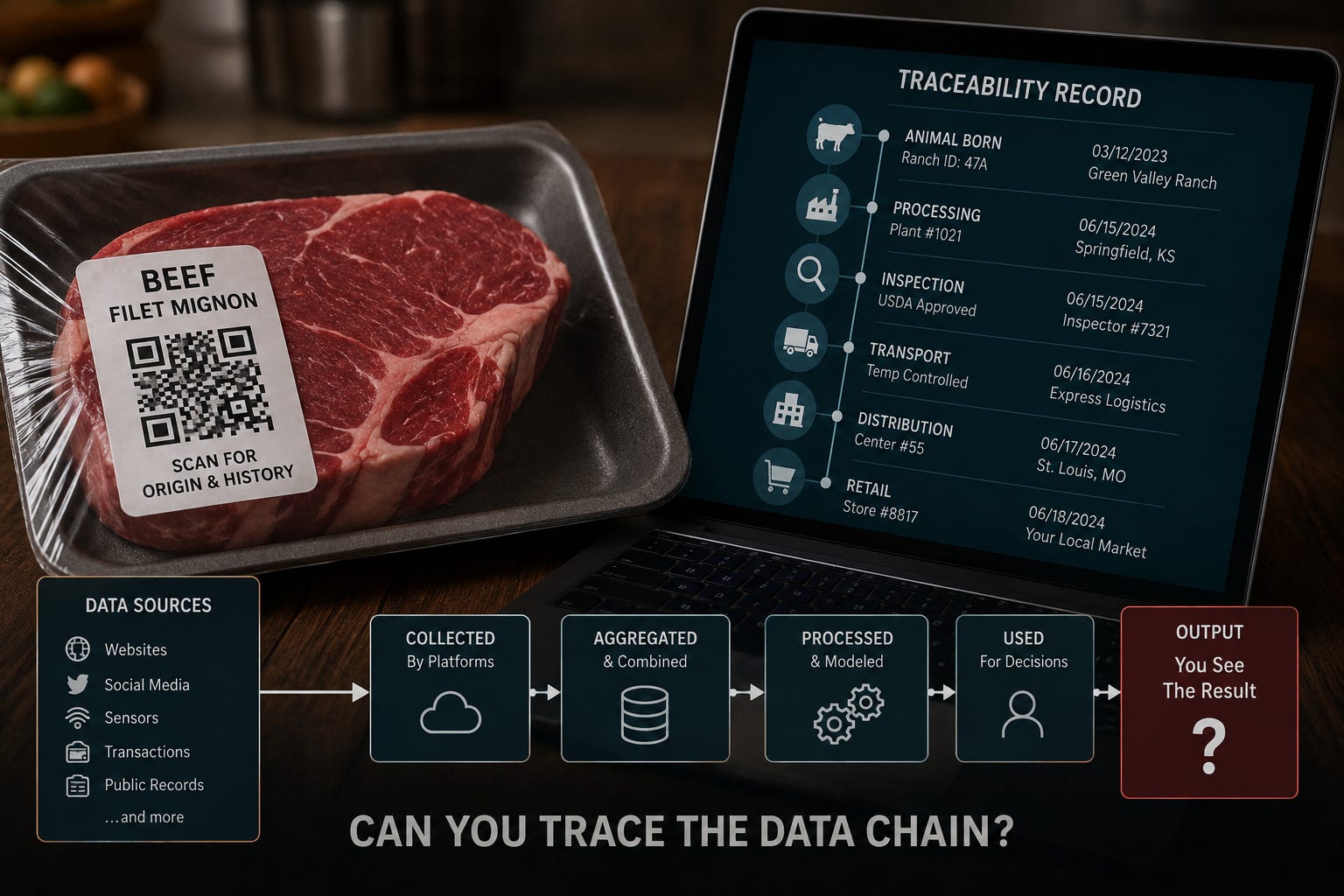
Imagine buying a filet mignon at the grocery store and finding a QR code on the package. You scan it and see something resembling the history of a FedEx shipment. You can see where the animal was raised, where the meat was processed, when it was inspected, how it moved through distribution and when it arrived at the retailer.
Not every consumer would care to examine all of that information. It might kill their appetite. That is beside the point. The point is that the record exists and somebody can reconstruct the chain if needed.
Of course, real food supply chains are complicated, and tracing a particular cut of meat all the way to an individual animal is not always practical. But that complication actually makes the analogy more interesting.
The filet is the easy case. The hamburger is where things get interesting.
Ground beef can contain meat from multiple animals, lots and processing runs. Once those inputs are combined, the finished product no longer has one simple lineage. It has a network of contributing sources.
And suddenly my strange obsession with meat starts sounding suspiciously like the internet.
We built the largest grinder in human history
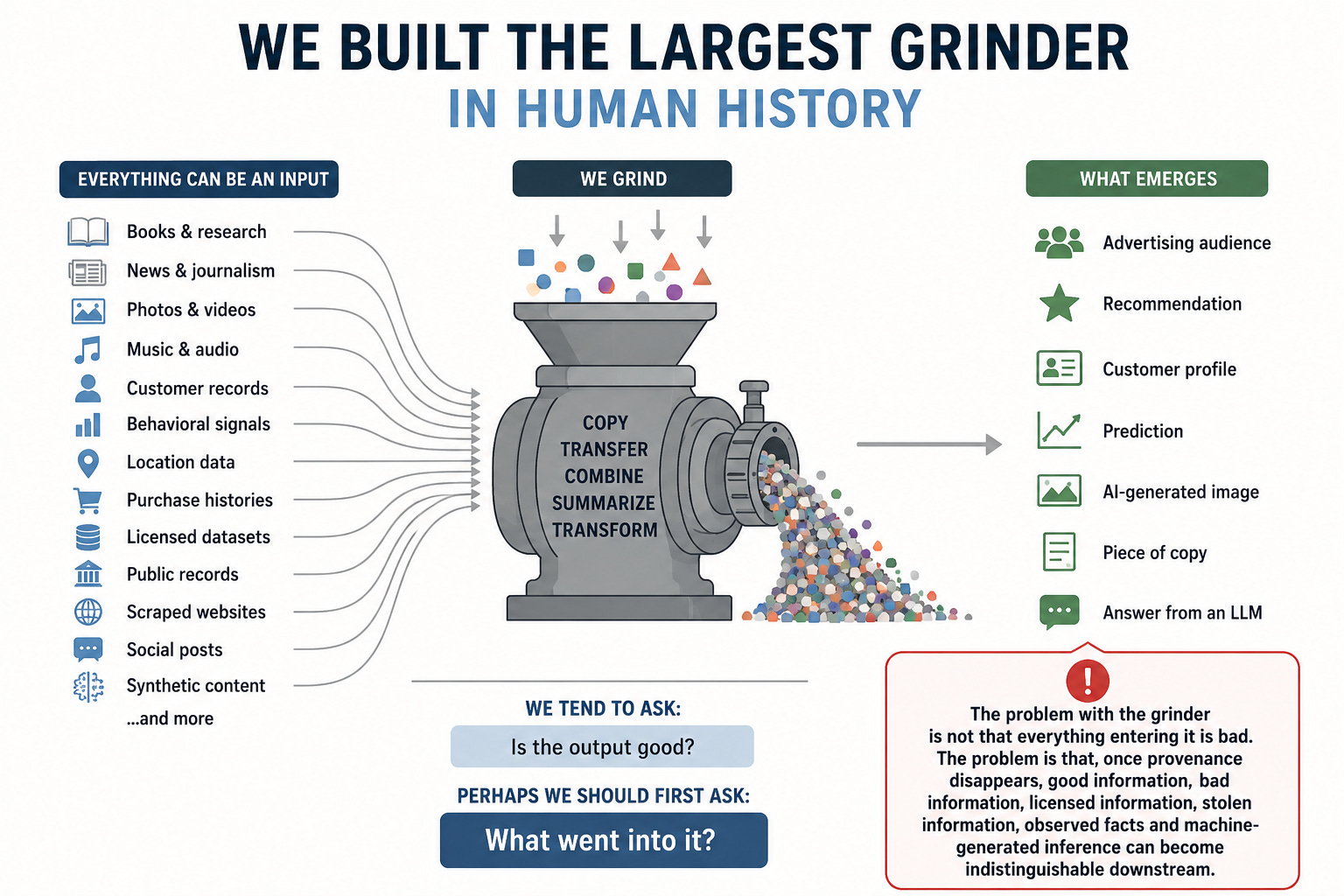
The modern information economy may be the largest aggregation machine human beings have ever constructed.
Almost everything we create, or record, can become an input: books and journalism, academic research, photographs and music, customer records, location histories, behavioral signals, transactions, public records, social posts, licensed datasets, scraped websites and, increasingly, synthetic material produced by machines themselves.
These things do not enter the system on equal terms. Some were deliberately published for anyone to see. Others were licensed for a specific purpose. Some remain protected intellectual property. Some describe people who may never have meaningfully agreed to the secondary uses now being made of their information. Some are carefully verified. Others are outdated, incomplete or simply wrong. Increasingly, some information has been generated by machines using earlier information whose own origins may already be difficult to reconstruct.
And then we grind.
We copy, transfer, aggregate, infer, summarize, model and recombine until the distinctions among the original ingredients become increasingly difficult to see. What emerges may be an advertising audience, a customer profile, a recommendation, a prediction, an AI-generated image, a piece of copy or an answer from a large language model.
We tend to encounter that finished product and ask if it is good. Is the recommendation accurate? Is the audience useful? Does the advertisement perform? Does the AI answer sound convincing?
Perhaps weare starting at the wrong end of the process.
Before asking if the hamburger tastes good, we might want to know what went into the grinder.
The problem with the grinder is not that everything entering it is bad. The problem is what happens when provenance disappears. Good information and bad information, licensed material and stolen material, observed fact and modeled inference, human expression and machine-generated content can eventually become indistinguishable downstream.
Once that happens, we have lost something more consequential than metadata. We have lost our ability to distinguish what we know from what we infer, what we own from what we borrowed, what someone permitted from what someone merely made accessible, and what can be demonstrated from what simply sounds plausible.
The grinder can still produce something useful. It can even produce something remarkably good. The problem is that we may no longer be able to explain why we should trust what came out.
This matters because much of the current conversation about artificial intelligence begins too late in the process. We debate output quality, model safety, disclosures, and labeling. Those are legitimate issues, but by the time we reach the finished output, many consequential decisions have already occurred upstream.
What information entered the system? Who created it? Who owned it? Under what terms was it acquired? What permission accompanied it? What happened when it was combined with other information? Did those permissions survive the combination? Can anyone reconstruct that history afterward?
If the answer to most of those questions is “we don’t really know,” putting an AI disclosure on the final product feels inadequate.
It is a little like putting a label on mystery meat that says, “Produced using an advanced grinder.”
This may be true, but it is not especially useful.
Provenance is not truth
This is where the analogy needs some discipline.
Provenance cannot tell us that something is good. It cannot even tell us that something is true.
A dataset can have impeccable provenance and still be wrong. A journalist can accurately identify a source who is mistaken. A photograph can be authentic while the interpretation attached to it is misleading. A consumer can provide information willingly, and that information can become outdated six months later.
Provenance answers a narrower but foundational question: Can we establish where this came from and what happened to it?
Truth requires additional tests. So do permission, quality, relevance, and fitness for purpose. These concepts are related, but they are not interchangeable.
Treating them as if they are is one reason the word “transparency” has become so convenient. Almost everyone supports transparency because the term can mean almost anything.
We need something more specific.
A piece of data can be true but obtained improperly. It can be properly obtained but inaccurate. It can be accurate and properly obtained but inappropriate for the decision being made. It can satisfy all three conditions and become misleading when its context is removed.
We need to distinguish source from truth, truth from permission, permission from integrity, and integrity from usefulness.
That is not simply a transparency problem. It is a chain-of-accountability problem.
The internet has a mixing problem
I stumbled into a remarkably good example of this problem while researching this article.
The thought about meat originally came from a real news story. President Trump announced that the United States would temporarily allow up to 300,000 metric tonnes of imported product for ground beef without the normal out-of-quota tariff, saying the additional supply would be sold at 25 percent below prevailing market prices. But there was an unusual omission: he did not identify which countries would supply the beef. Agriculture Secretary Brooke Rollins subsequently said the sources had not yet been finalized.
That caught my attention for reasons that had little to do with Trump or politics. My reaction was much more basic: We’re talking about meat. Don’t we want to know where it came from?
Then I encountered a second, completely real story.
A New York Times investigation published just days earlier examined what was happening to federally protected wild horses removed from public lands by the Bureau of Land Management. The Times followed, among other cases, 68 wild mustangs transported to an Ohio livestock trader who purchased them for $25 each. A day later, according to the reporting, two cattle trucks arrived, loaded the horses and drove away. The buyer would not disclose where the horses went and denied selling them for slaughter. But the Times found livestock inspection records showing that some mustangs sold through the government program subsequently appeared on trucks headed for slaughter plants in Canada.
So now I had two stories in my head at the same time.
One involved a large quantity of imported beef whose countries of origin had not yet been disclosed. The other involved American wild horses whose path through the supply chain had become difficult to follow, with evidence that some federally sold mustangs had entered a foreign slaughter pipeline.
Then I began encountering claims and insinuations online that seemed to connect the two: mystery beef, horses being slaughtered, meat moving across borders, and questions about where it was all coming from.
It made for one hell of a story.
There was only one problem.
I could not establish that the stories were connected.
I could verify the beef story. I could verify the horse story. I could verify that provenance was a legitimate question in each. What I could not verify was the bridge between them.
And that realization may be more interesting than the story I originally thought I had.
This is how information gets mixed.
Nobody needs to invent every ingredient. In fact, the most persuasive questionable claims often contain plenty of truth. Take one verified fact from one story. Add another verified fact from somewhere else. Place them next to each other. Add a plausible inference. Remove some context. Repeat the resulting narrative often enough and eventually the distinction between what was reported, what was inferred, and what was merely repeated becomes difficult to see.
The ingredients themselves may be real.
The hamburger isn’t.
And I almost served it.
That is why provenance matters. I could trace the individual ingredients, but I could not establish the chain connecting them. Without that chain, I had no business presenting the combined story as fact.
Now imagine this happening not in the head of one person writing an article, but billions of times across the internet.
An original investigation becomes a derivative article. The derivative article becomes a social post. The social post becomes somebody else’s summary. The summary enters a dataset. The dataset becomes an input to an AI system. The AI produces a confident answer. Someone quotes that answer in another article, which eventually becomes another input.
At no individual step does somebody necessarily have to lie.
That is what makes the problem so difficult.
After enough transformations, a claim can acquire the appearance of authority while becoming increasingly detached from the evidence that originally supported it.
So asking “Is this true?” is necessary, but it is no longer sufficient.
We also need to ask: What was actually observed? What was reported? What was inferred? Who made each claim? What transformations occurred between the original evidence and the version now in front of me? And can I still work my way backward through that chain?
Because if I cannot, I may be holding something that looks like information without knowing what is actually in it.
Which brings us, once again, back to the hamburger.
From the hamburger to the Trust Stack
These questions are not merely theoretical for me. I am part of an IEEE Standards Association Industry Connections / Institute for Advertising Ethics (IAE) initiative examining the use of artificial intelligence in human-powered advertising. The group is developing an AI Advertising Trust Stack: a framework for thinking systematically about what has to be true for people, companies, and machines to place justified trust in AI-mediated advertising.
I have been working on this alongside Sean Meier, CEO and co-founder of VRFD, with a particular interest in a deceptively simple question: when an AI system makes a claim, recommendation, or decision, what evidence should exist to establish where its inputs came from, what it was authorized to do, and what it actually did? Our group is focused on Technical outputs.
The broader Trust Stack effort approaches this problem from several directions. One of those is Intent Alignment, which asks what the system was supposed to accomplish, whose intention it was acting on, and what boundaries surrounded that intention.
This effort is critical because “the AI did it” is rapidly becoming one of the least satisfactory explanations in business. Machines do not appear from nowhere with independent commercial purposes. Someone selected the system. Someone supplied objectives. Someone provided or permitted access to data. Someone established constraints. Someone decided its output was trustworthy enough to act on.
If we want accountability at the end of that process, we need to understand intention at the beginning.
Think. Say. Do.
During these discussions, Stone Shen, a member of the Trust Stack’s Intent Alignment group and one of the people helping shape how the initiative thinks about the relationship between human intention and AI behavior, introduced a framing that has stuck with me: Think. Say. Do.
Think. Say. Do.
Its strength is its simplicity. Almost anyone can understand it, yet it exposes a sophisticated accountability problem.
What did the system think it was authorized to do?
What did it say it was doing?
And what did it actually do?
Those three things should correspond. More importantly, somebody should be able to demonstrate that they correspond.
An AI system can have the right stated intention and still behave differently. It can behave correctly while describing its actions inaccurately. It can disclose one set of rules to a consumer while executing another set of instructions somewhere deeper in the technical stack. It can even produce an apparently successful outcome while violating the permissions or constraints that were supposed to govern how it got there.
That is where this stops being an abstract conversation about “trustworthy AI” and becomes an accountability problem.
Intent without evidence is a promise. Disclosure without evidence is a claim. Trust requires some way to connect what was intended, what was represented, and what actually happened.
And that brings me straight back to the hamburger.
If someone tells me the package contains beef, that is the say.
If the system was designed and authorized to source inspected beef from approved suppliers, that is something like the think.
What actually entered the grinder is the do.
The label, intention, and standards matter. But ultimately there has to be enough evidence running through the system to establish that the contents correspond to the claim.
Data and AI present the same problem at a radically larger scale.
A system may say that it uses permissioned data. A company may intend for its AI to respect intellectual-property rights. An advertising platform may state that it will not use certain sensitive information for targeting.
Accountability begins when we can test them against what actually happened.
Carry the proof forward
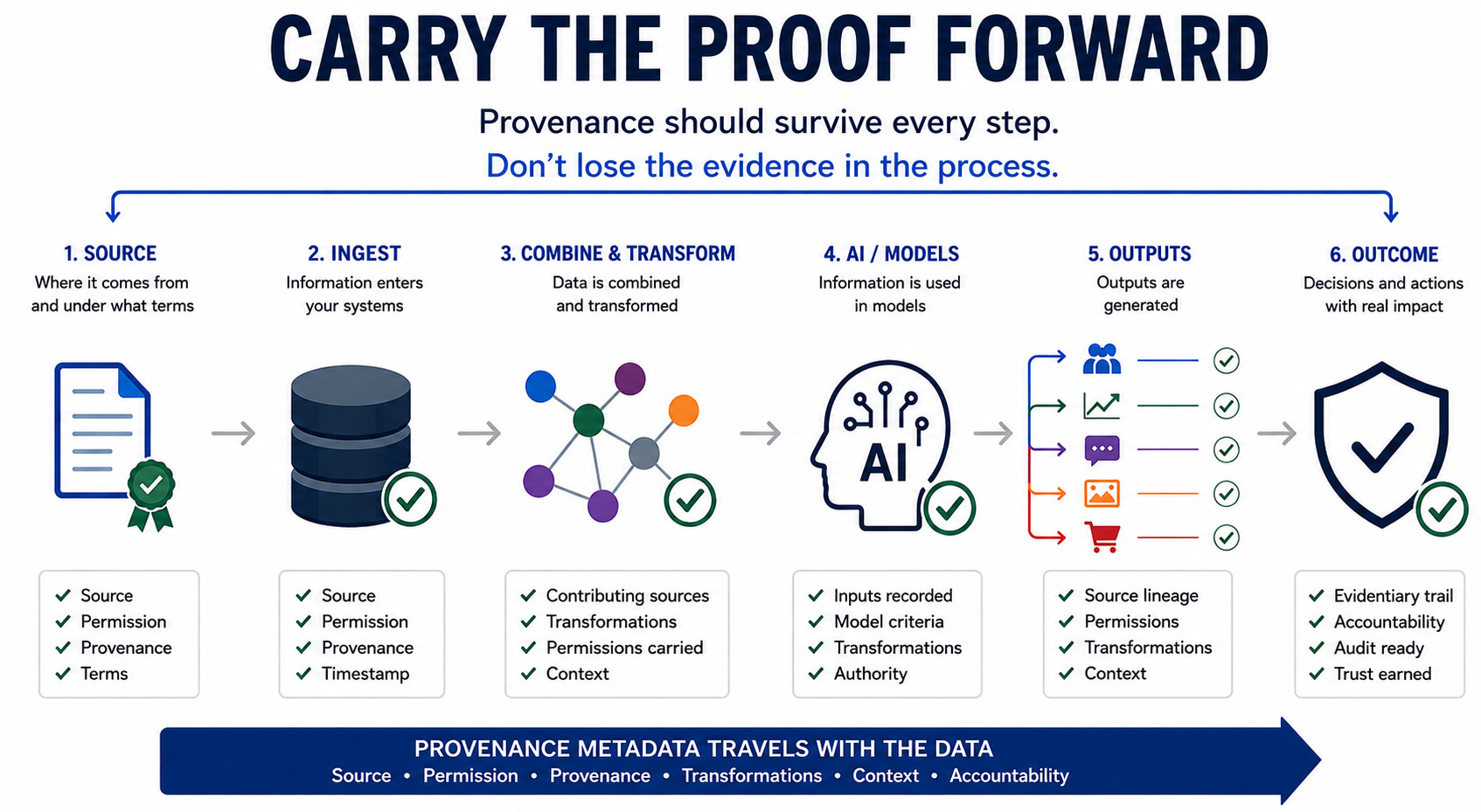
This is where provenance becomes more than an interesting technical feature. It becomes part of the evidence.
If information changes hands, information about its source should not simply disappear. If permission was limited, those limitations should not vanish when the data enters another database. If multiple datasets are combined, we should retain enough information to understand the contributing sources. If an AI system transforms material, there should be some record of what occurred and under what authority.
I have started thinking about this as carrying the proof forward.
You cannot wait until the end of a complicated AI process, inspect the finished hamburger, and magically reconstruct everything that disappeared inside the grinder. Some evidence has to survive the process itself.
Source. Permission. Provenance. Transformation. Context. Accountability.
This does not mean attaching a 400-field digital birth certificate to every data point on Earth. That would be a very technology-industry response to a legitimate problem: create something so elaborate that almost nobody uses it.
The better principle is proportional accountability. The greater the consequence of a decision, the stronger the evidence we should expect behind it.
This is also why the different parts of the Trust Stack have to connect. Intent needs to become something that can later be tested. Disclosure needs to correspond with observable behavior. Provenance needs to survive transformation. Accountability needs an evidentiary trail.
Otherwise, we risk creating a sophisticated vocabulary for trust without creating a way to know when trust is deserved.
Data needs a chain of custody
Other industries already understand this principle.
Evidence in a legal proceeding has a chain of custody because the connection between the object and the event matters. Financial systems maintain transaction records because ownership and transfer matter. Pharmaceutical manufacturers track lots because, when something goes wrong, “we sold quite a few pills around then” is not a satisfactory answer. Food systems maintain traceability because contamination without traceability can turn a localized problem into a much larger one.
These systems are not perfect. Records can be falsified. Inspections fail. Fraud occurs.
But nobody seriously argues that imperfect provenance means provenance has no value.
Digital information seems to have received a peculiar exemption.
For decades, the digital economy created enormous value by separating information from its origins. Copying became almost free. Distribution became instantaneous. Aggregation became profitable at enormous scale. The distance between creator and commercial user grew so large that the original source often disappeared from view.
Artificial intelligence did not create this condition.
It industrialized it.
And now the consequences are becoming harder to ignore because machines increasingly act on information rather than merely displaying it.
Provenance changes economic value
An economic question deserves far more attention.
Two datasets containing superficially similar information should not necessarily have the same value.
One may have known sources, explicit permissions, documented transformations, recent verification and an accountable party. The other may contain information scraped from assorted places, copied through several intermediaries, partially synthesized and accompanied by no reliable record of how it was obtained.
Calling both simply “data” hides an enormous difference.
We would never price two diamonds identically simply because they were the same size. We would not value two paintings identically because they contain the same amount of canvas and paint. We do not value two used cars identically after learning that one has a complete maintenance history and the other has an unexplained three-year hole in its records.
Provenance is information about information.
And information about information has value.
I suspect the data economy will eventually have to recognize this more explicitly. Clean, permissioned, and verifiable information should be worth more precisely because so much of the alternative has become difficult to inspect.
This matters to marketers as much as it matters to technologists.
Suppose an audience segment tells me that 100,000 people are “high-intent automobile buyers.” What exactly am I buying?
Did those people say they were interested in buying cars? Were they observed visiting automotive websites? Was that characteristic inferred from unrelated behavior? Was the information purchased from another data provider? How old is it? How confident is the model? Did the people represented have any meaningful understanding that their behavior would be used this way?
The label on the segment may be identical.
The ingredients may be radically different.
That difference should affect both the value we assign to the data and the confidence we place in decisions made from it.
Back to the meat
I do not know if every hamburger needs a QR code capable of introducing me personally to the cows. Probably not.
I am also not suggesting that food traceability provides a ready-made technical architecture for artificial intelligence. Analogies become dangerous when we mistake them for engineering specifications.
But the instinct behind traceability is worth taking seriously.
When something consequential passes through many hands, we expect records. When materials are combined, we expect standards. When someone makes a claim about what a product contains, we expect that claim to be capable of verification. When something goes wrong, we expect to be able to work backward through the chain.
And when nobody can explain where something came from, our confidence generally decreases.
Why should data be different?
Perhaps the most important question for the AI economy is not simply:
Can I trust this output?
Perhaps it is:
Can you show me enough of its history that I can decide for myself?
That seems like an extraordinarily ordinary expectation.
We already demand versions of it from food, medicine, money, property, art and evidence.
Maybe I am crazy.
But if we care enough about provenance to ask what is in the hamburger, we should probably care what we are feeding the machines that increasingly influence what people see, buy, believe and do.
And if nobody can tell us what went into the grinder, “trust us” should no longer be an acceptable answer.
A note on this essay
The ideas in this essay reflect my own thinking as it develops through my participation in the IEEE Standards Association Industry Connections work on the AI Advertising Trust Stack. They should not be read as findings, conclusions, or positions of IEEE, the initiative, or its working groups. That work is still underway, and the group will reach its own conclusions through the collaborative process.
I am sharing these thoughts now because the questions are too important to discuss only behind closed doors. They affect marketers, technologists, creators, consumers, and anyone whose data becomes an input into an increasingly automated information economy.
I also do not want this work to operate as a black box. These are difficult questions, and better answers will come from exposing our thinking to people who see the problem differently.
So consider this an invitation. Challenge the analogy. Find the holes. Add something we have missed. If you have a perspective, criticism, or idea that could strengthen this thinking, I welcome it and will bring relevant feedback into the working-group conversation.
The point is not to pretend we already have the answers. It is to make sure we are asking the right questions in public while we work toward them together.