


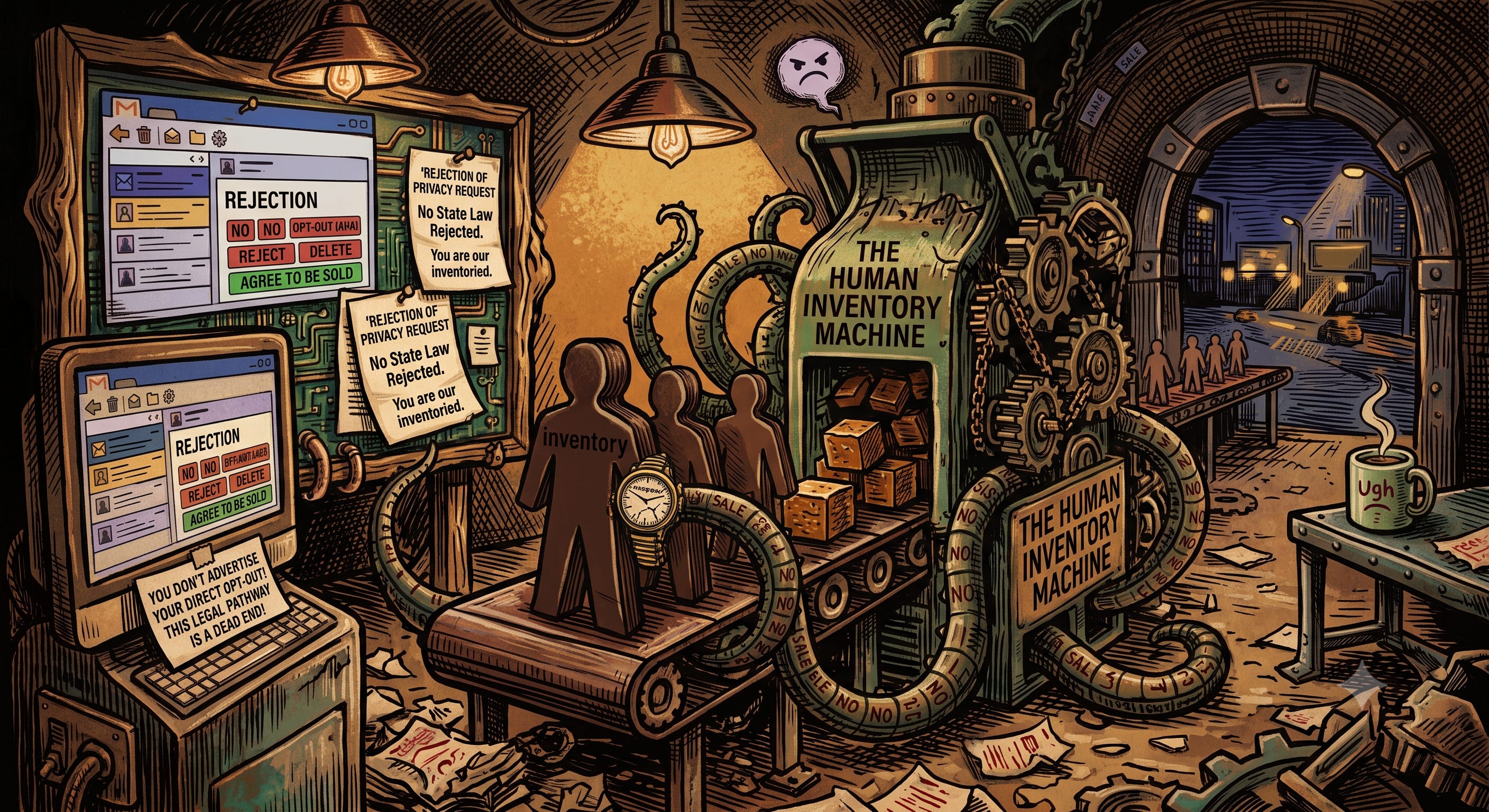
So I decided to clean up my digital footprint and asked PeopleFinders to remove my personal data from their site.
My full name, current home address, phone numbers, past locations, and list of relatives are all sitting right there on their public site for anyone—stalkers, scammers, you name it—to see.
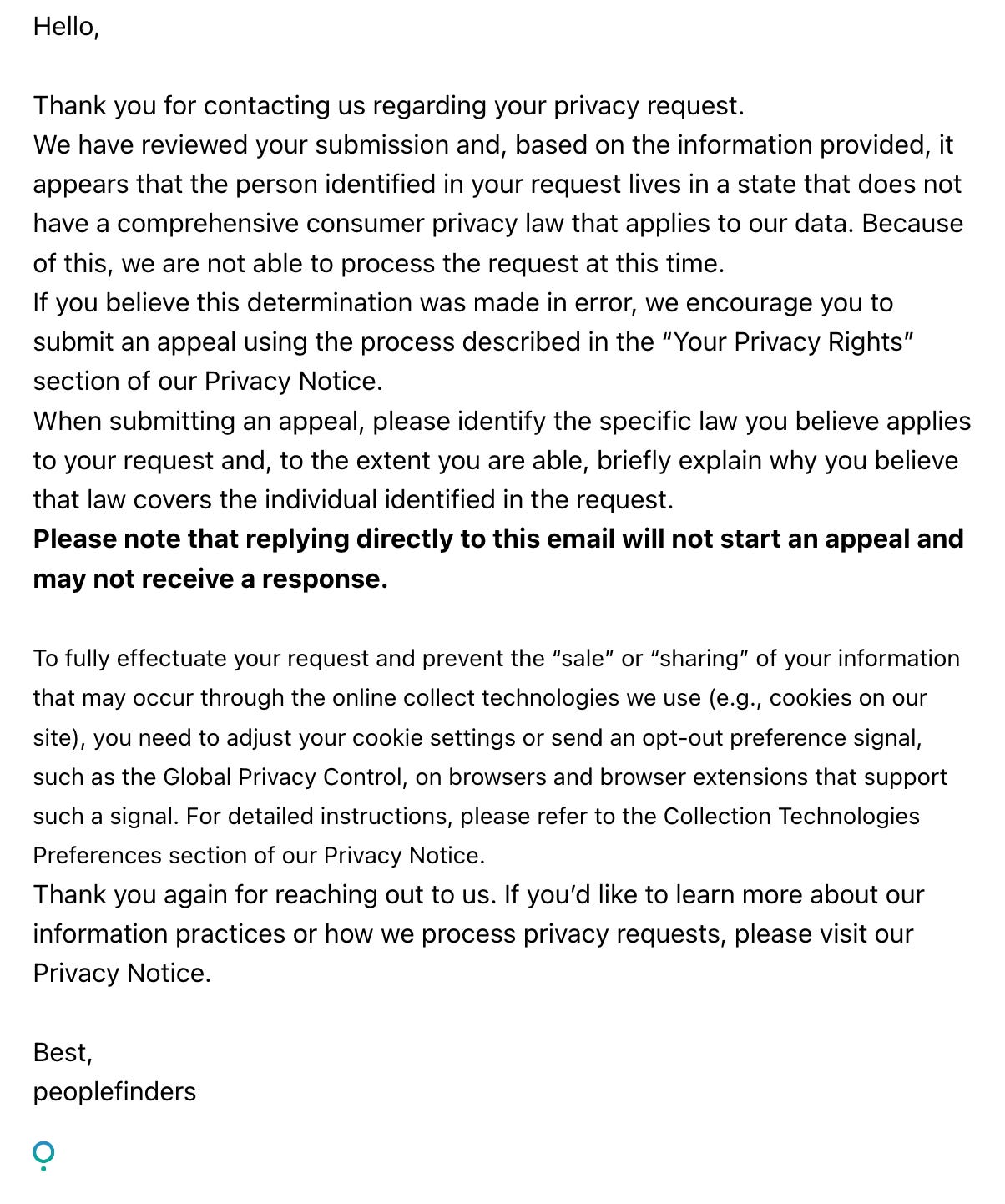
I filled out their official privacy request, waited, and just received this absolute slap in the face:
“We have reviewed your submission and, based on the information provided, it appears that the person identified in your request lives in a state that does not have a comprehensive consumer privacy law that applies to our data. Because of this, we are not able to process the request at this time.”
Translating corporate legal-speak into plain English: “Because your state politician hasn’t passed a law forcing us to stop profiting off your private life, we are choosing to keep selling your address to anyone with a credit card.”
This cold response is the exact “dirty data” extraction model that organizations like the Clean Data Alliance are fighting against. But to understand why a company responds with such blatant indifference, you have to look under the hood at where they came from and how the machine actually works.
This is the note:
The Origin Story: From Public Utility to Corporate Hoarders
PeopleFinders was founded in 1999 by Rob Miller, a former private investigator who spent the 1980s working for Intel Corporation.
In the early days of the internet, the pitch sounded almost noble: Democratize public information. In the late 1990s, if you wanted to find a long-lost relative, an old military buddy, or verify an address, you had to physically go to county courthouses and sift through microfiche. Digitizing public records was sold as a helpful public utility.
So what happened? How did a tool meant for reconnecting people turn into a system that refuses to delete your address even when your personal safety is at risk?
The short answer: SEO algorithms, subscription models, and venture scale.
In the late 2000s, PeopleFinders realized that instead of charging a one-time fee to look up an old friend, the real money was in recurring subscription traps and Google search dominance. They built automated bots to scrape over 120 billion records, creating a dedicated landing page for virtually every adult in America.
Once your human identity becomes an indexed “page” on Google that generates subscription revenue, you are no longer a customer — you are inventory.
The Anatomy of “Dirty Data”: Why They Reject You
When PeopleFinders says “you have a good reason to remove your data, but we don’t have to by law, so we won’t,” they are executing a deliberate business strategy known as regulatory arbitrage.
Here is why they choose to act this way:
Law Equals Ethics (The Corporate Lie): PeopleFinders isn’t saying they can’t remove my data — they’re saying they won’t because no regulator is holding a legal gun to their head. They treat basic human privacy as a legal compliance chore rather than a fundamental ethical standard.
Privacy as a Regional Privilege: If I lived in California, Virginia, or Colorado, they’d legally have to process my deletion request. But because of where I draw breath, they tell me to kick rocks. Your personal safety shouldn’t depend on state borders.
Voluntary Deletion Shrinks Their Assets: To a company built on Data-as-a-Service (DaaS), every deleted profile represents lost search traffic and lower corporate valuation. Admitting that an unprotected citizen has a “valid reason” to be deleted sets a precedent that threatens their entire database of 250+ million Americans.
The Cookie Shell Game: In the very same email, they tell you to “adjust your cookie settings” or use Global Privacy Control. Changing cookie preferences stops them from tracking your browser while you’re on their site — it does nothing to delete your home address from their public database.
Profiting off Personal Danger: Abuse survivors, stalking victims, and everyday people dodging scammers are forced to jump through legal hoops or pay expensive removal tools just to hide where they sleep at night. Meanwhile, PeopleFinders sits back and collects a check.
Bonus Comedy: The “Over 2,000 5-Star Ratings” Trustpilot Illusion
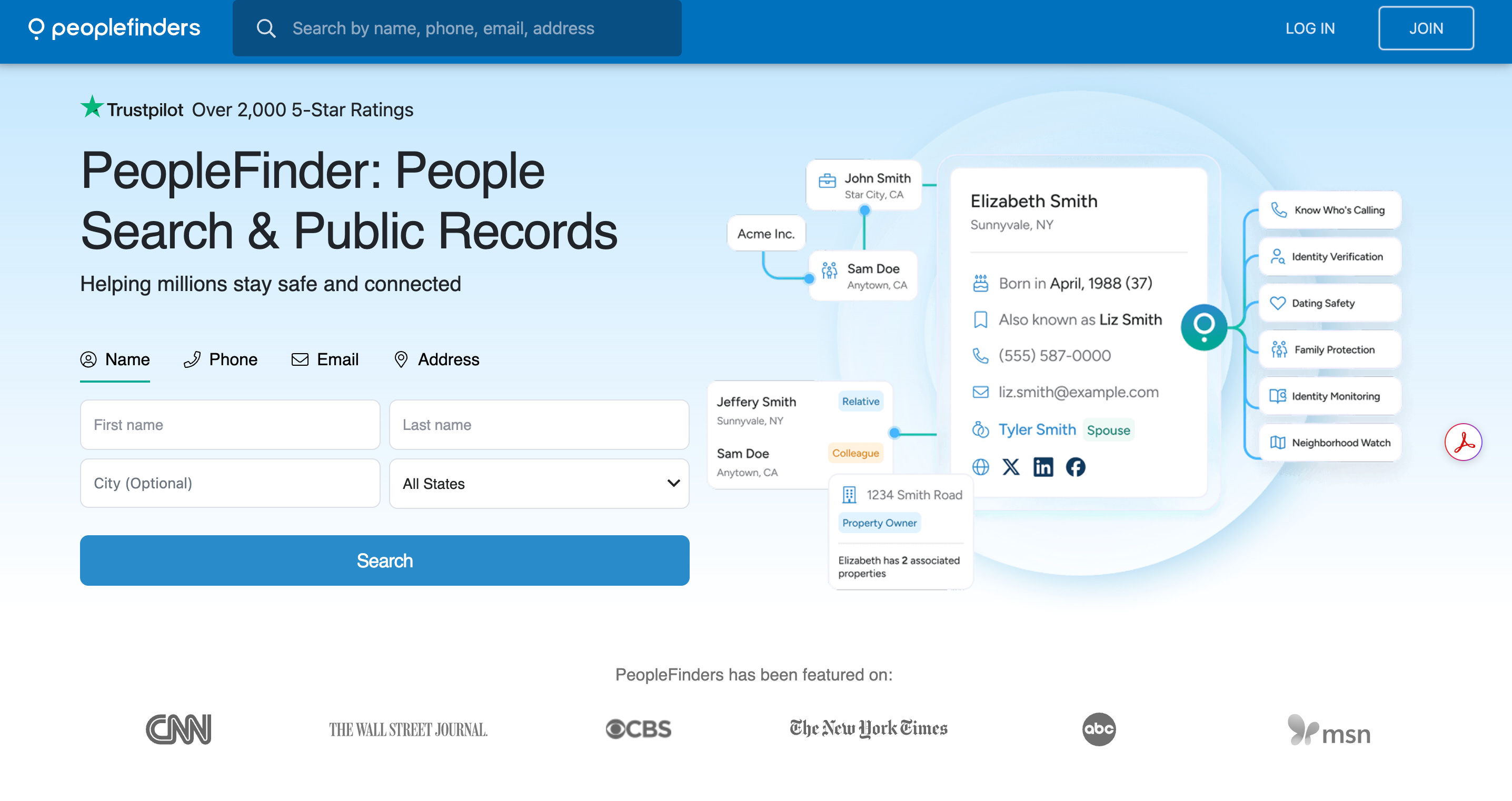
If you visit the PeopleFinders homepage, they prominently display a badge boasting: “★ Trustpilot: Over 2,000 5-Star Ratings.”
When a surveillance-capitalist data broker flexes thousands of glowing reviews, your immediate thought should be: Who on earth is passionately leaving a 5-star review for a public records scraper?
If you actually dig past the slick marketing banner, the absurd irony reveals itself. I went to Trustpilot myself to see this.
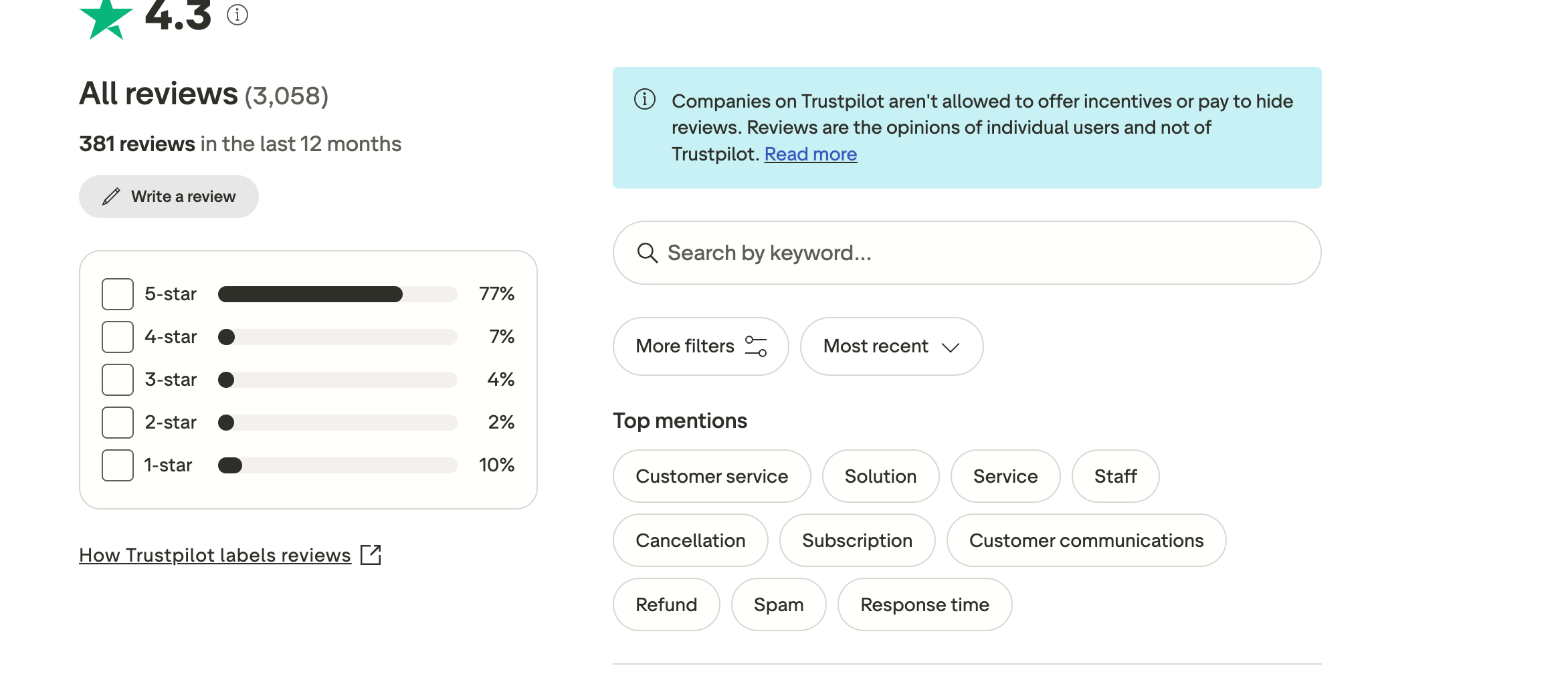
First, there’s the cherry-picked metric trick. Noticing how they specifically chose to say “Over 2,000 5-Star Ratings” instead of displaying their actual overall score or mentioning their dismal ratings on ConsumerAffairs or SiteJabber? If you have over 3,000 total reviews and a massive chunk of your user base is screaming about unauthorized credit card charges, you simply ignore the angry victims and put the rest on a shiny banner!
Second, those 5-star reviews fall into two hilarious buckets:
The “Hostage Negotiation” Demographic: “I accidentally got sucked into a $30/month subscription trap, but ‘Luis’ from customer service was very polite while giving me back half my money! 5 stars!” (You don’t get a gold star for handing back a stolen wallet just because you smiled while doing it.)
The Accidental Stalkers: Creepers who are ecstatic that for $0.95, they managed to track down an ex’s home address or a neighbor’s personal cell number.
Enter the 10% Club: What the 1-Star Reviews Actually Reveal
While PeopleFinders parades its 5-star metric, a full 10% of its entire Trustpilot footprint consists of brutal, 1-star warnings. And when you read through what actual users are experiencing, it turns out that 10% is where the unvarnished reality lives.
Here is a quick snapshot of the patterns dominating the negative feedback:
The $0.95 Cent Trap: Virtually every single 1-star review tells the exact same story. Users pay $0.95 or $1.00 expecting a one-time lookup, only to discover buried fine print enrolled them into a recurring $25 to $32 monthly subscription. By the time their credit card alerts them, the company refuses refunds.
The “Robo-A.I. Stole My Money” Strategy: Multiple reviewers report trying to resolve billing disputes, only to be stonewalled by automated customer service. As one reviewer put it: “They’ve taken a couple of hundred out of your account... when you call them they say A.I. says you signed up... God help us all!!”
Peak Corporate Gaslighting: The absolute pinnacle of comedy is watching PeopleFinders’ automated customer service bot reply to negative feedback on Trustpilot. When a user named Larry left a 1-star review stating “Lousy and was never able to look up anything,” the automated bot immediately replied: “Larry, We’re happy to hear that we successfully addressed your problem and kept you informed! Thank you for your positive feedback...”
Bragging about “2,000 5-star reviews” while maintaining a 10% trail of furious consumers—all while actively denying millions of Americans the legal right to delete their home addresses—isn’t a badge of honor. It’s a confession.
The Paradigm Shift We Need
Companies like PeopleFinders prove that we cannot rely on corporate goodwill or wait for 50 individual state legislatures to pass piecemeal privacy laws.
We need to shift away from this “scrape first, hold hostage later” paradigm. If a company cannot operate on explicit permission, total transparency, and fundamental human respect, its business model shouldn’t exist in a civilized society.
(P.S. If anyone else got this rejection: don’t use their legal/privacy portal. Search for “PeopleFinders direct opt-out form” directly or email privacy@peoplefinders.com demanding a standard opt-out instead of a state-based privacy claim. They usually process standard opt-outs without checking your zip code.)