


Stew Leonard’s is a Northeast institution; part dairy store, part Disneyland, famous for friendly service and “farm-fresh” fun.
Its 2016 privacy policy shows a company doing exactly what most businesses were taught to do: collect responsibly, protect securely, and market efficiently.
They’re not doing anything wrong.
In fact, Stew Leonard’s represents best practice by traditional standards; the same standards that defined the last 20 years of digital commerce.
But at the Clean Data Alliance, we’re building a new playbook, one that replaces extraction with agency.
Just because you can profit from customer data doesn’t mean you should.
What Aligns with Clean Data Principles
Even though this policy predates the Data Agency era, it does contain a few commendable traits.
1. Transparency of Collection and Use
Stew Leonard’s lists what’s collected — names, IPs, cookies, purchases — and explains why: personalization, service, and marketing.
CDA lens: Transparency is a first step toward truth, a Clean Data core value.
2. User Choice and Opt-Out Options
Customers can unsubscribe from emails or request deletion by contacting support.
CDA lens: Manual consent revocation is an early gesture toward revocable consent, a right CDA treats as essential.
3. Commitment to Security
SSL/TLS encryption is mentioned — still a crucial foundation for protecting verified data.
CDA lens: Data integrity and security are baseline Clean Data expectations.
4. No Declared Sale of Personal Data
Stew Leonard’s says it doesn’t sell or rent personally identifiable information, except when needed for services.
CDA lens: Limiting data resale aligns with CDA’s “permissioned agent” approach — when honored, it builds trust.
Where It Reflects the Old “Dirty Data” Economy
The gaps in this policy aren’t unique; they’re universal.
They mirror an entire era of “acceptable” digital behavior built around corporate data ownership rather than human data rights.
1. Implied, One-Time Consent
Using the app equals agreement to the entire policy.
CDA contrast: Consent should be dynamic, revocable, and contextual; not automatic.
2. Broad, Undefined Data Use
Data can be used for “personalized offers” or shared with “companies we think may interest you.”
CDA contrast: Clean Data demands specificity, purpose limitation, and visible consent logs.
3. No Value Exchange
User data fuels marketing and analytics but the user receives no share of that value.
CDA contrast: Data Agency means “give to get.” What if we generate a micro-payment or benefit for the user?
4. Persistent Identifiers and Third-Party Tracking
Cookies and analytics tools track users across sessions, with vague external opt-out options.
CDA contrast: Clean Data must be anonymous, aggregated, and fully permissioned.
5. Undefined Retention and Portability
No indication of how long data is kept or how users can retrieve it.
CDA contrast: Users deserve to see, move, and delete their data with logs of every action.
6. Limited Child Data Protection
While discouraging minors from sharing data, the site still allows voluntary collection.
CDA contrast: Clean Data requires verified parental consent and automatic data expiry for minors.
Summary Table
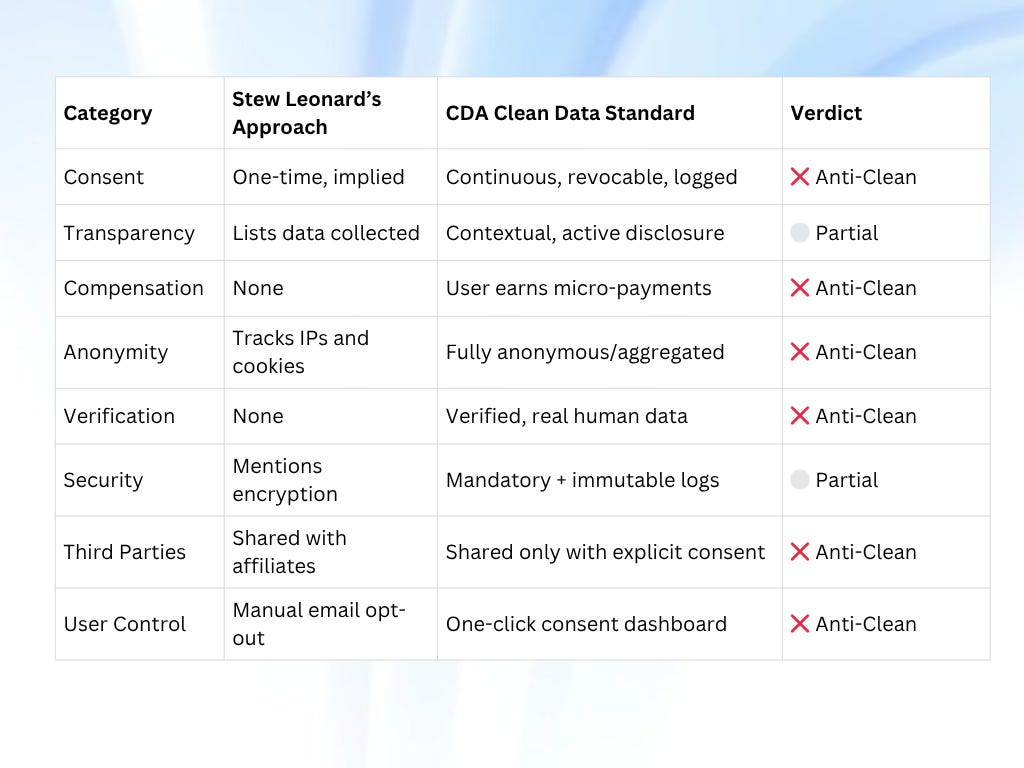
How Stew Leonard’s Could Go Clean
Stew Leonard’s built its legacy on trust, honesty, and transparency.
Those same values could make it a national model for Clean Data Retail.
Here’s how they could lead the next wave:
Launch a Customer Data Dashboard
Let shoppers view, edit, and revoke consent anytime, not through emails, but in a clean, intuitive interface.Reward Data Sharing Fairly
Offer microcredits, coupons, or loyalty points whenever customers opt into anonymized data analysis, turning consent into collaboration.Adopt Immutable Consent Logs
Record every data transaction transparently so customers can see exactly who accessed their information, when, and why.Verify and Anonymize Data by Design
Replace cookies and trackers with verified, permissioned, anonymized customer records. Clean Data at its purest.Become a Clean Data Certified Retailer
Join the Clean Data Alliance to showcase ethical data stewardship and inspire other regional brands to follow.
Bottom Line
Stew Leonard’s isn’t breaking rules; it’s following a playbook the world outgrew.
The next chapter isn’t about compliance. It’s about conscience.
Just because you can extract and profit from consumer data doesn’t mean you should.
The Clean Data Alliance invites companies like Stew Leonard’s and every organization built on trust to help write the new standard:
Data that’s verified, permissioned, transparent, and shared fairly.
Because the future of business isn’t built on taking more.
It’s built on earning trust and giving back.