


Just the other day, a highly targeted ad flashed across my screen. It was an intake looking for previous Oscar Health customers. Having been an Oscar customer myself, I clicked through, read the filing details, and immediately joined the claim within minutes. You should too. But more importantly, we need to talk about why this case matters to the entire digital economy.

For years, the prevailing playbook for digital enterprise relied on scraping as much behavioral data as possible, embedding third-party tracking pixels covertly, and monetizing the output behind a wall of legacy legal fine print. But the financial bill is finally coming due.
If you want to see exactly how the tide is turning, just look at Lantern by Labaton. Developed by the law firm Labaton Keller Sucharow, Lantern is a direct-to-consumer digital intake platform designed for mass consumer arbitration and class-action claims. Right now, its active portal targets companies like Oscar Health, Babylist, Hoopla, and Grubhub.
The charge? Allegedly using hidden tracking pixels and SDKs to transmit sensitive, unpermissioned user data to third-party ad networks without explicit, clean consent.

For those of us at the Clean Data Alliance (CDA), Lantern represents the monetization of corporate data violations, and it sits at the furthest, most aggressive end of what we call The Clean Data Continuum.
To fix the broken data paradigm, we must understand how the market moves from proactive prevention to reactive punishment, and why the current legal wreckage proves our architecture is no longer optional.
The Clean Data Continuum
The data market does not operate in a vacuum. Every organization sits somewhere on a spectrum of data hygiene, moving from pure structural integrity to existential legal risk.
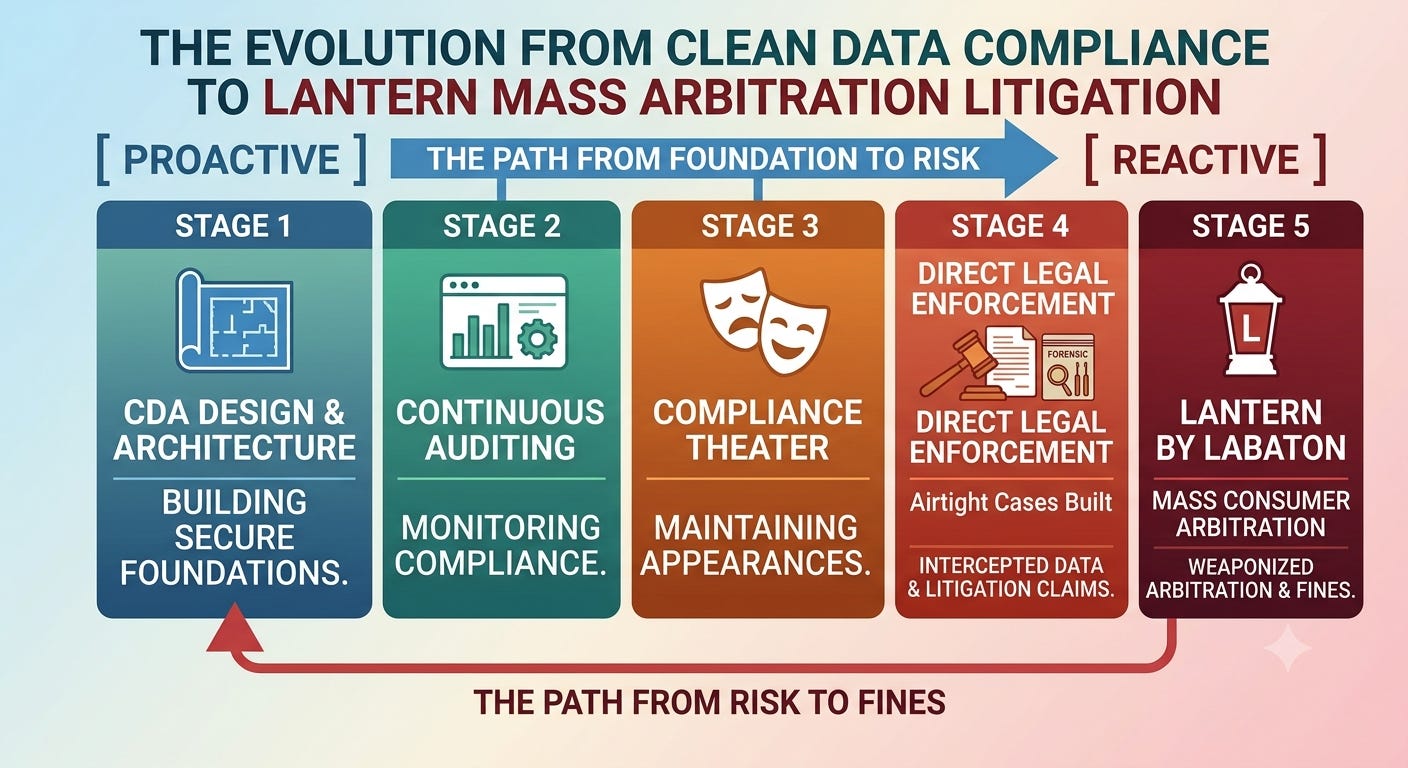
1. Proactive Phase: Architecture & Prevention (The CDA Core)
This is the starting point of a healthy digital ecosystem. The goal here is to design systems so that data leaks and unpermissioned sharing are structurally impossible from day one.
The Mechanism: Open data standards, decentralized identities, and strict data minimization rooted in our Electronic Bill of Rights (EBOR).
The Action: Engineers build applications using a certified data architecture. Third-party trackers and covert SDKs are stripped out at the root.
The State: Total insulation from risk. The company cannot lose or misuse “Dirty Data” because they choose not to hoard it.
2. Active Phase: Continuous Auditing & Certification
For established companies transitioning away from legacy extraction models, this is the critical buffer zone between safety and danger.
The Mechanism: Enterprise monitoring, data provenance mapping, and CDA hygiene certifications.
The Action: Corporations utilize diagnostic frameworks to audit outward data pipelines, ensuring that rogue marketing pixels aren’t quietly scraping user onboarding data behind the scenes.
The State: Real-time data hygiene. Vulnerabilities are deprecated before external harm or legal exposure ever occurs.
3. Defensive Phase: Regulatory Compliance Theater
This is where the vast majority of corporations sit today. It is technically reactive to privacy laws, but superficially proactive toward avoiding lawsuits.
The Mechanism: 50-page privacy policies, forced consent checkboxes, and legacy legal blockades.
The Action: Companies hire legal teams to write convoluted Terms of Service that force users into mandatory arbitration, trying to legally cover their tracks while continuing to exploit data.
The State: Extreme vulnerability. This phase relies entirely on users not reading the fine print—a gamble that is rapidly failing.
4. Reactive Phase: Direct Legal Enforcement
When compliance theater inevitably fractures, and a company secretly routes protected behavioral or medical data to marketing APIs, it crosses into the fully reactive phase.
The Mechanism: Investigative plaintiffs’ law firms and forensic software telemetry audits.
The Action: Data packets are intercepted and analyzed. Firms like Labaton build airtight legal cases behind closed doors, proving that a corporation violated its fiduciary duties and consumer privacy.
5. Hyper-Reactive Phase: Mass Consumer Aggregation (Lantern)
This is Lantern’s exact operational domain. It is the execution engine of the reactive phase, turning consumer grievances into a streamlined, digital assembly line.
The Mechanism: Consumer-facing ad funnels, micro-intake forms, and digitized client portals.
The Action: Lantern serves targeted ads to affected users. Within two minutes, a passive consumer completes a questionnaire, signs an e-retainer, and joins a multi-million dollar mass arbitration framework—effectively weaponizing corporations’ own mandatory arbitration clauses against them by drowning them in upfront filing fees.
The State: Total systemic correction via severe financial penalty.
Closing the Loop: Why the Market is Changing
The continuum is not a straight line; it is a closed loop.
When platforms like Lantern aggregate thousands of consumers and impose massive financial penalties on corporations (Labaton has recouped over $30B for clients to date), they change the economic math of the entire tech sector. They act as the ultimate market motivator.
Lantern proves that “Dirty Data” is no longer a monetizable asset—it is an existential corporate liability. The financial wreckage left in the wake of these massive privacy lawsuits creates the exact market pressure that drives companies backward along the continuum. It forces them to abandon the illusion of compliance theater and seek out true, certified data hygiene.
At the Clean Data Alliance, our goal is to render reactive platforms obsolete by helping companies build right the first time. But until the rest of the corporate world catches up, we recognize the vital role of the reactive hammer.
If Lantern is the entity that forces a company to reckon with the consequences of its data exploitation, the CDA is the blueprint they buy into to ensure they never end up on that dashboard again.