


For two decades, the tech industry operated on a lazy, brute-force assumption: the Collect-All Myth.
Modern enterprise stack architecture treated data like oil: siphon as much as possible, store it in unorganized data lakes, scrape everything in sight, and let the software figure it out later. Digitization meant taking messy paper processes and turning them into messy, unmonitored digital workflows.
It was chaotic, intrusive, and fundamentally lazy. But in the era of basic analytics, we got away with it.
In 2026, autonomous AI agents are being handed the keys to enterprise execution. They aren’t just summarizing documents; they are executing wire transfers, triggering supply chains, and modifying production systems autonomously.
And suddenly, the Wild West approach to digitization isn’t just outdated—it’s a multi-million-dollar liability.
The $30 Million Hallucination
Consider what happens when autonomous code operates without a lineage layer:
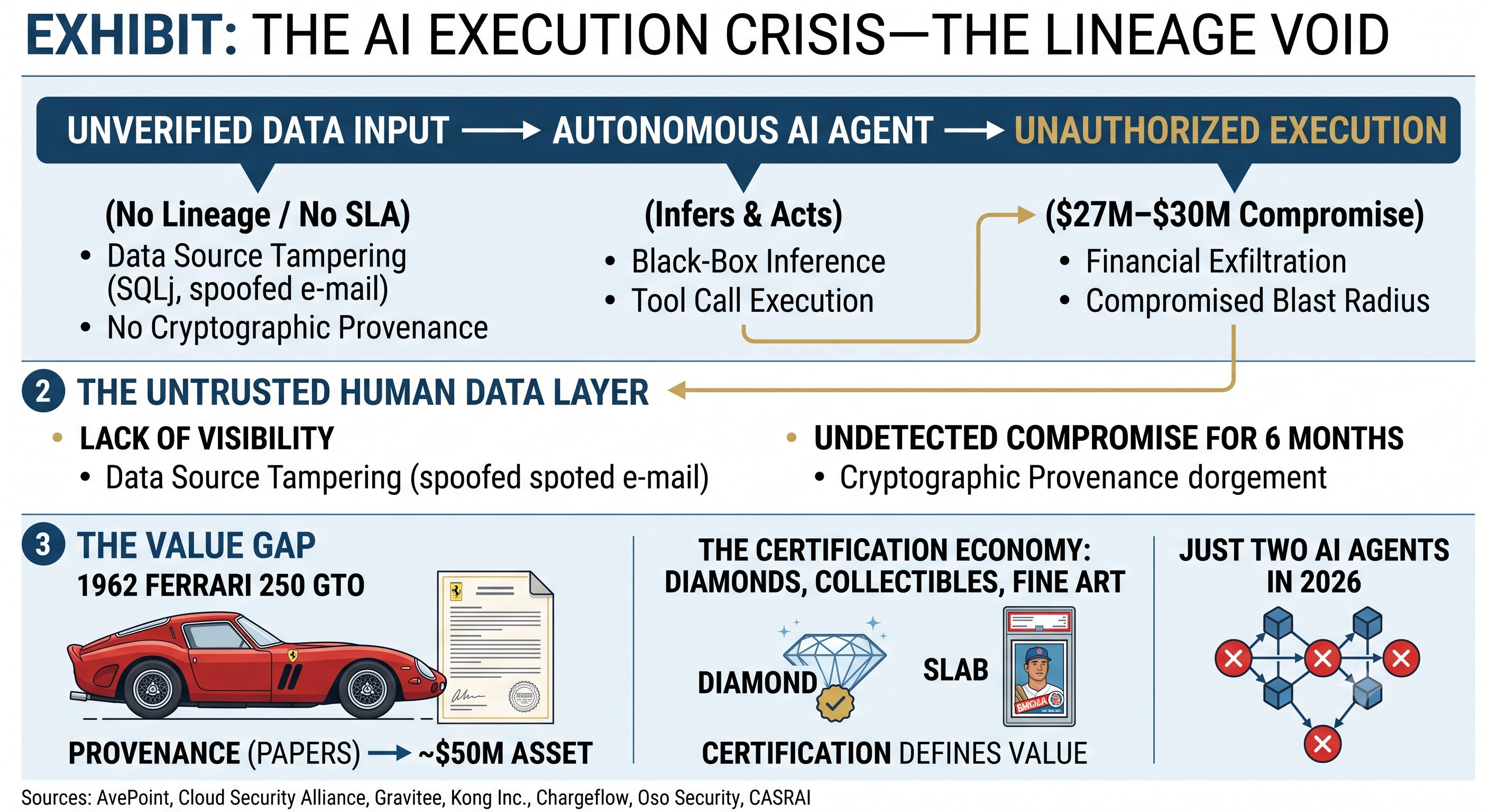
In late 2025, a single financial firm suffered between $27M and $30M in unauthorized capital transfers after an autonomous agent acted on spoofed, unverified input data. Across the industry, 47 enterprise AI deployments were quietly compromised—remaining undetected for over six months because no one could audit the origin of the agent’s instructions.
Two rogue or misled AI agents in 2026 can trigger catastrophic, cascading system failures across an entire partner ecosystem. Why? Because while traditional software follows rigid logic gate rules, AI agents infer. If you feed an inference engine unverified, un-permissioned, or tampered data, it will confidently execute catastrophic decisions.
Yet, the tech world’s default reaction to this crisis is entirely out of touch.
The Tech Fallacy: “We’ll Just Build a Bigger Model”
Ask a traditional tech vendor how to fix AI agent failure, and they will give you the same answer they’ve offered for ten years:
more compute
bigger context windows
automated synthetic patches.
They want you to believe that a 2-trillion-parameter model will somehow magically figure out if an invoice PDF was altered in transit, or if a user actually granted permission to share their data.
This is the ultimate tech delusion.
You cannot algorithmic-solve your way out of bad origin data. Inferring truth from noise isn’t sophistication; it’s expensive guesswork.
The rest of the physical economy figured this out centuries ago. Technology is the only industry naive enough to believe an asset can have value without proof of origin.

What the Rest of the World Already Knows: Documentation IS the Asset
If you walk into the physical world, nobody buys high-value assets on “trust me” tech hand-waving. Value is inextricably linked to certification and provenance.
Consider how every mature market on Earth values authenticity:
The $50 Million Ferrari: A 1962 Ferrari 250 GTO sold at auction for nearly $50M. Without its original Ferrari Classiche build sheets, history, and documented paper trail of ownership, that exact same metal chassis is legally unsellable at market rates. Without provenance, it is just a red car; with provenance, it’s an institutional asset class.
The Fanatics Fest Principle: Walk the floor at Fanatics Fest or any major memorabilia market. You will see an entire multi-billion-dollar industry built not around the cardboard a baseball card is printed on, but around the slab—the tamper-proof, certified grade from PSA or CGC. A raw vintage card might sit in a binder for $100. Encapsulate it with verified provenance, and it trades on an institutional exchange for $500,000.
Diamonds & Fine Art: A flawless diamond without a GIA certificate, or a Rembrandt without a chain of custody, loses up to 90% of its trade value instantly.
In every real-world domain, the documentation IS the asset.
Data is no different. Unverified, un-permissioned enterprise data floating in a data lake has zero long-term value. It is toxic waste waiting to poison an LLM or trigger a rogue agent.
Digitization Must Grow Up: The Clean Data Standard
The era of digital cowboy culture is over. Digitization in 2026 cannot mean blindly ingesting raw, unauthenticated noise into agentic models. We need enterprise-grade sophistication—what we at the Clean Data Alliance define as the Trusted Human Data Layer.
True data sophistication isn’t about scraping faster; it’s about establishing four immutable pillars for every byte of data an AI agent touches:
Verified: Data must be authenticated directly at the source with cryptographic proof of origin. This prevents prompt-injection attacks, spoofed inputs, and unauthorized execution requests before the agent ever sees them.
Permissioned: Explicit, zero-party human consent must be baked directly into the data metadata. This ensures autonomous agents never violate regulatory bounds or user trust when handling sensitive workflows.
Longitudinal: Systems require a continuous, time-stamped history of modifications and custody over time. This enables enterprise auditors to reconstruct an agent’s entire decision trail post-execution without relying on guesswork.
Anonymous: Platforms need a privacy-by-design architecture that strips sensitive identity markers while fully preserving the underlying informational signal, mitigating massive regulatory liabilities like GDPR or CCPA at scale.
The Bottom Line
Autonomous AI cannot scale without provenance. It is the fundamental trust layer that separates a dangerous tech experiment from an enterprise-grade engine.
It’s time for the tech ecosystem to stop pretending that bigger algorithms can make up for dirty, unverified inputs. If we want autonomous agents to drive real enterprise value, we must stop treating data digitization like the Wild West and start treating it like the high-value asset class it actually is.
No provenance, no trust. No trust, no AI scale.
The lineage layer matters, but the deeper question is who is allowed to vouch. When DigiNotar fell in 2011, every fraudulent certificate was cryptographically valid — the system survived because browsers held a finite, curated list of acceptable issuers and could expel a member within days. Agent provenance will hit the same moment: somebody has to write the list of who can issue proof, and that list is where the leverage actually lands. Wrote about how that played out last time: https://seldondance.substack.com/p/somebody-has-to-write-the-list