

Your Enterprise Data Strategy Has a Liability Hidden Inside It
Why Traditional Data Models are Now a Liability

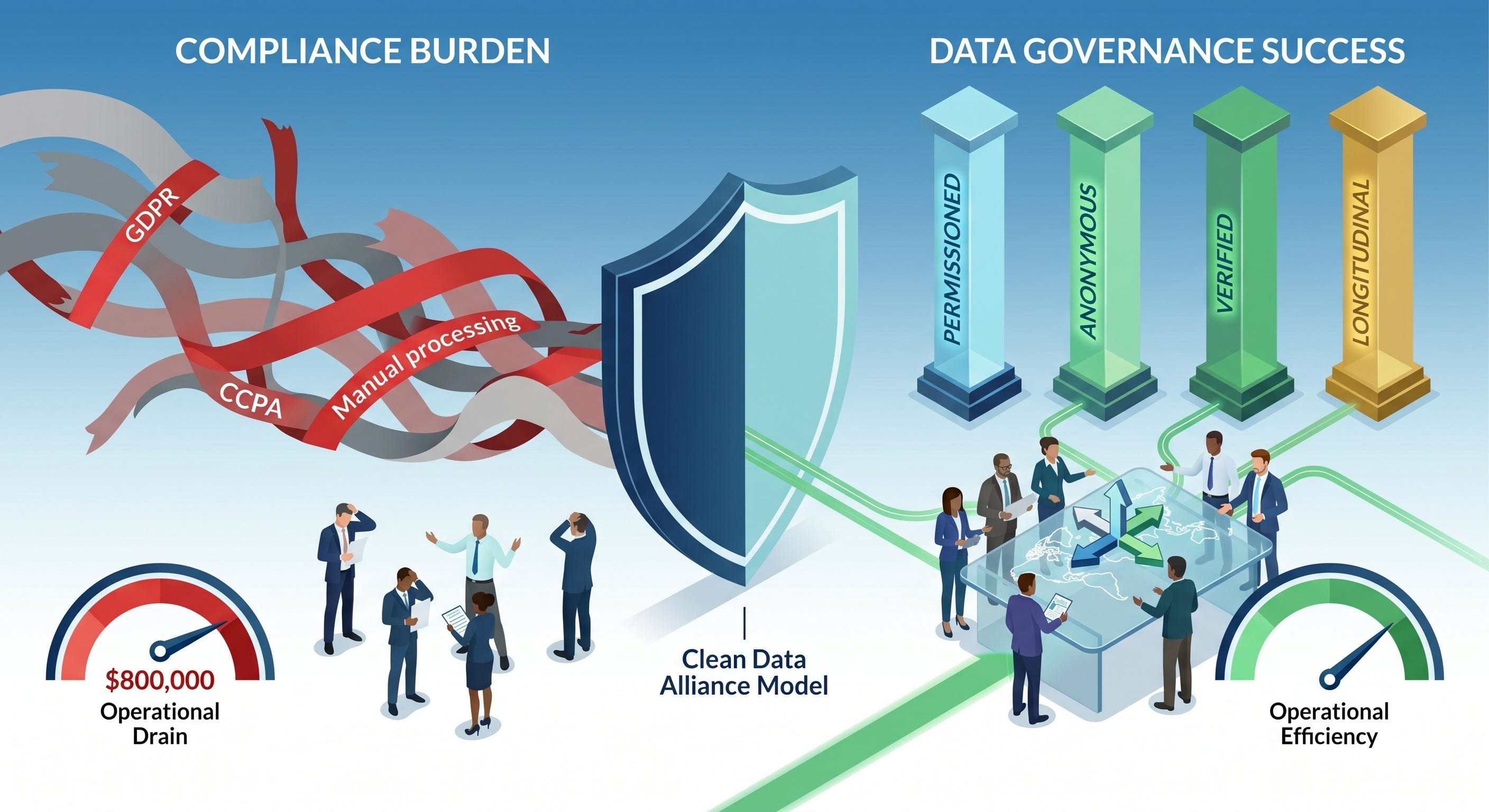
In 2023, DataGrail tracked a 246% increase in consumer data subject requests compared to 2021. For the modern enterprise, this isn’t just a legal hurdle; it’s a massive operational drain. Manually processing these requests costs companies roughly $800,000 per million consumer identities.
With California’s CCPA amendments projected to generate $4.2 billion in first-year compliance costs alone, the financial landscape for data management has shifted. Beyond regulation, there is the issue of utility: 31% of organizations report that poor data quality costs them at least 20% of annual revenue (Validity, 2024).
For Chief Data Officers (CDOs) and IT Directors, the challenge is no longer just “managing” data; it is determining whether your data architecture is a proactive asset or a reactive liability.
Why Traditional Data Models are Now a Liability
The legacy data supply chain was built for an era of extraction. Data brokers scraped and aggregated profiles without explicit consent, while third-party cookies tracked behavior in the shadows. This model functioned until a “perfect storm” of three factors hit the market:
Regulatory Pressure: Global laws (GDPR, CCPA, etc.) have moved from theory to aggressive enforcement.
Consumer Sovereignty: Customers today are increasingly aware of their digital footprints and demand transparency.
The AI Requirement: AI models are only as effective as their inputs. When 24% of CRM admins report that less than half of their data is accurate, every downstream AI initiative inherits those errors.
Traditional vendors often focus on volume over integrity. Their incentive is to sell more data, not necessarily better data. However, when a regulatory inquiry arrives, the vendor isn’t the one held accountable—the enterprise is.
The Four Pillars of “Clean Data”
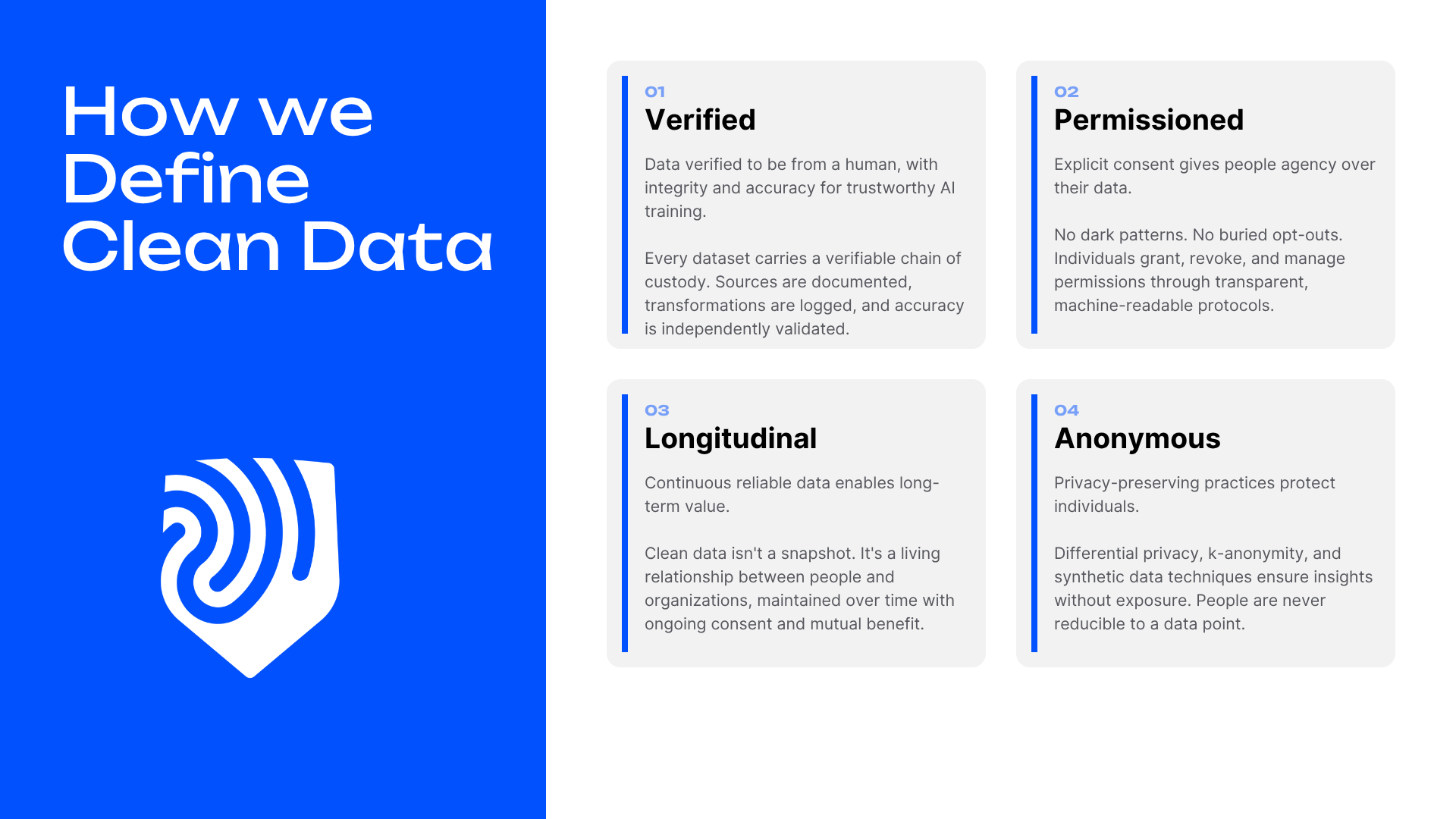
To mitigate risk, the Clean Data Alliance has established the “Clean Data” framework. This standard moves away from inferred snapshots and toward data that is structurally sound across four specific dimensions:
1. Permissioned — Consent That Holds Up Clean Data starts with explicit, individual-level consent. Not a buried checkbox, but documented permission from a real person who agreed to share their data for a specific purpose. This creates a defensible legal foundation for everything downstream.
2. Anonymous — Protecting the Legal Perimeter Individual identity must be protected by design. This means data carries no personally identifiable information (PII) that could trigger a breach notification or a “do not sell” demand. This allows organizations to use data without the inherent risks of storing sensitive IDs.
3. Verified — Human-Centric Accuracy Anonymity does not have to mean a lack of trust. Every data point should come from a confirmed human being rather than a bot or synthetic profile. This ensures that targeting models and segmentation logic are built on reality.
4. Longitudinal — Combatting Data Decay Consumer data has a short half-life. The Longitudinal pillar ensures data is updated over time, reflecting how people actually evolve. This provides models with the context that point-in-time snapshots simply cannot provide.
The “Consent Burden” and Structural Risk
Large enterprises frequently spend upwards of 300 hours on manual cleanup after a single consent enforcement failure. Remediation—including labor, platform fees, and data loss—can exceed $250,000 per incident.
While many organizations attempt to solve this by layering Consent Management Platforms (CMPs) onto their existing tech stacks, this often addresses the symptom rather than the cause. The organization still carries the ultimate liability. A more sustainable approach involves sourcing data that is “clean” from the point of origin, ensuring that the permission is baked into the record itself.
The Role of Nonprofit Governance in Data
When evaluating data partners, risk committees increasingly look at organizational structure. Traditional commercial brokers are subject to market volatility, acquisitions, and shifting business models that can compromise their data ethics over time.
In contrast, the emergence of 501(c)(6) nonprofit organizations in the data space offers a different governance signal. Because these organizations exist to serve an industry mission rather than shareholder returns, they offer:
Mission Stability: The commitment to data principles is structural and less likely to pivot based on quarterly earnings.
Aligned Incentives: The goal is the integrity of the data ecosystem rather than upselling into higher-margin products.
Industry Self-Governance: Much like professional standards bodies, these alliances provide a framework for organizations to operate with shared credibility.
Future-Proofing the Data Stack
The trajectory of data privacy is more regulation, higher fines, and greater consumer scrutiny. Enterprises still relying on legacy brokers and patchwork internal systems are building on an increasingly unstable foundation.
The transition from data extraction to data partnership is the defining shift for the next decade of IT leadership. By moving toward a model of Permissioned, Anonymous, Verified, and Longitudinal data, organizations can stop reacting to the latest privacy headline and start building a stack designed for the future of the digital economy.
Moving Beyond Reactive Compliance
The regulatory landscape is no longer a future concern; it is a current operational reality. For organizations relying on legacy data models, the risks of manual processing costs and revenue loss are accelerating.
If the move toward a permissioned, anonymous, and verified data ecosystem aligns with your organizational goals, we invite you to join the conversation. We are currently establishing and organizing this framework to help enterprises navigate the transition from data liability to data integrity.
Connect With Us
We are actively building the future of clean data. If this model makes sense for your strategy, we would like to talk to you.
Reach out to Jay Mandel to discuss how we are organizing this initiative and how your organization can move from reactive compliance to proactive data excellence.